The main goal of this two-part post will be to study the homomorphisms out of the earring group. Click here to get to Part II. In particular, we’ll end up concluding that the set of homomorphisms  to the additive group of integers is countable. This may seem a bit strange considering
  is an uncountable group. As a direct consequence, we can see that is not isomorphic to any free group
  on a set
  .
.
Theorem 1 (de Smit [1]): is not isomorphic to a free group.
The earring group is complicated enough that this should not be completely obvious. In this post I’ll fully hash out the details of Bart de Smits proof in [1]. Working through all these details has certainly helped me understand it better.
Theorem 1 is in contrast with the fact that the fundamental group  on a countable wedge of circles (the earring with the CW-topology) is isomorphic to the free group
  on a countably infinite set of generators.
The earring group
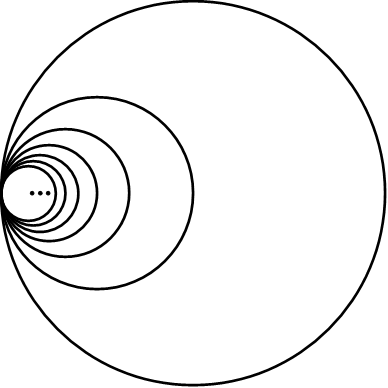
In a previous post, I discussed how to begin understanding the algebraic structure of the fundamental group of the earring space  , where
  is the circle of radius
  centered at
  . The basepoint is the origin
  , the one point where the shrinking circles meet.

We decided that the fundamental group is an uncountable group that could be understood a subgroup of the inverse limit

where  is the free group on the generators
  and the map
  identifies the letter
  to the identity element (or empty word). The inverse limit
  consists of sequences
  where
where  is obtained from
  by removing all occurrences of the letter . The fundamental group corresponds to a certain subgroup of .
Definition: Suppose  is a reduced word in the letters . Reduced means that
  and
and  for each
  . The k-weight of
  is
is
 .
.
Essentially,  is the number of times
  or
or  appears in .
If 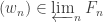 , then the sequence
  (for fixed
  ) is non-decreasing since the projections
  only delete letters. We wish to consider the elements of the inverse limit where each such sequence is also bounded (and thus eventually constant). Let

be the subgroup of consisting of sequences where every k-weight is eventually constant. These sequences are usually called locally eventually constant sequences and the group  is often called the free
  -product of
  .
.
In a previous post, we found the following canonical group isomorphism.
Theorem 2:  .
.
So to study the properties of the earring group, we can focus our attention on the purely algebraic structure of . For instance, is certainly uncountable and also must be torsion free since it is a subgroup of the torsion free group .
Some homomorphisms out of
First let’s exploit the inverse limit structure of to construct some interesting self-homomorphisms of . For simplicity of notation, we’ll just write  for the element
  where the first non-trivial term is in the k-th position. More generally, we could also identify
  with it’s image under the canonical embedding
  of the infinite free group.
Consider a sequence  of locally eventually constant sequences. The
  should satisfy the follow two properties:
 for all
- For all
 and
and  , we have
For instance, we could have something like:
 which corresponds to an infinite word
 which corresponds to an infinite word
 which corresponds to an infinite word
and so on…
What is important is that 1) the first  terms of are trivial and that 2) the letters
  don’t show up in .
Condition 1) means precisely that the sequence must converge to the identity element  when has the inverse limit topology, i.e. as a subspace of
  .
.
Lemma 3: There is a self-homomorphism  where
where  .
.
Proof. Define a homomorphism  on the free group by
  (obviously for
  ). Since

and

the following diagram commutes.
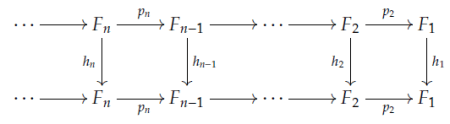
Consequently, we get a self-homomorphism  on the inverse limit such that . We check that
  and then use the restriction of
  to prove the lemma. If
  then for each
  , we have
  . Now for fixed :

The inequality must be there since when we replace each letter  of
of  with
with  , we may have some word reduction to do. Our restriction that for all and means that

Since, by assumption,  , we have
  . Thus

showing that  is locally eventually constant.
Now let’s see what happens when we map to the additive group of integers .
Lemma 4: If  is a homomorphism, then there is an
  such that
  for all
  .
.
Proof. Suppose  for
for  and let
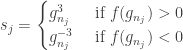
By Lemma 3, there is a homomorphism  such that for all
  . Thus
  for each . We might as well now replace
  with
with  so from now on let’s assume that
 .
.
Ok, now let’s define a special sequence  that will help us arrive at a contradiction. We define the n-th term
  to be
to be
\begin{cases} 1 & \text{ if }n<j\\ g_j & \text{ if }n=j \\ g_jg_{j+1}^{a_j} & \text{ if }n=j+1 \\ g_j(g_{j+1}g_{j+2}^{a_{j+1}})^{a_j} & \text{ if }n=j+2 \\ g_j(g_{j+1}(g_{j+2}g_{j+3}^{a_{j+2}})^{a_{j+1}})^{a_j} & \text{ if }n=j+3 \\ … & … \end{cases}
So the general form for  is
is
 .
.
Notice that removing from  gives
gives  and that
  for (i.e. the letter
  never appears more than
  times despite the fact that the appearances get further and further apart). Thus
  is a well defined element of .
The main feature of this sequence is that  so that when we apply , we get

Iterating this formula times for  gives
gives

So if we let
 and
and  ,
,
then we see that  and thus

Let’s make a few more observations about  and
and  :
:
Proof: this one is pretty obvious since  .
.
Proof: Since , we have  and inductively if
  ,
,  .
.
Proof: Here we also use the fact that for each  . Notice
 ,
,
 ,
,
 , and so on.
If we recursively define the increasing sequence  ,
,  , we get
  , which does the trick.
Added Remark: de Smit’s construction uses , however, the inductive proofs of these three bullet points also seem to work if you only assume  . So actually, I believe this slight simplification can be made.
Now, let’s finally finish the proof of Lemma 4 by showing that satisfies way to many modular equations.
In general, suppose  where
where  . If
. If  , then we must have
  and if
  , then we must have
  .
.
Consequently, if  , then we must have
  for all since
  and
and  . But this contradicts the fact that
  . On the other hand, if
  , then we must have
  for all
  but this contradicts the fact that
  .
.
References.
[1] B. de Smith, The fundamental group of the Hawaiian earring is not free, International Journal of Algebra and Computation Vol. 2, No. 1 (1992), 33-37.





![g_n=[\ell_n]](https://s0.wp.com/latex.php?latex=g_n%3D%5B%5Cell_n%5D&bg=ffffff&fg=333333&s=0&c=20201002)











 is not isomorphic to a free group.
 to the additive group of integers is in bijective correspondence with the (obviously uncountable) set
  of functions
  . However, according to Theorem 7 (which we prove below),
  is isomorphic to the direct sum
  , which is countable. Therefore, we can conclude that
  be the subgroup of
 , the group
  and
and  and
and  used in the two groups are mutually exclusive we can use the uniqueness of reduced words in free groups to prove this lemma. In particular, we need to show that any element of
  where
where  and
and  (where at most one of
  or
or  is allowed to be the identity).
 . By definition,
  for all
  , there is a
  such that
  for all
  . Let
. Let  . Thus the appearances of the letters
  . Rather, we can only get
  from
from  by adding letters
  ) in between the already present elements of
  and
and 
 . We can demand that at most one of
  may be an identity element. Let
  be the projection when
  . Then if
 .
.  for all
  for some
  . By Lemma 5, we can (for each
  where
where  . Basically,
  by deleting all appearances of the letters
  and thus
  for each
  is a homomorphism such that
  for all
  and this contradicts
  !
!  induced by collapsing the first
  , but a priori it is not clear that you get the next step
  unless you have the free product decomposition!
 given by
  is an injection onto the direct sum
  , there is an
  . The natural map
  collapsing the
  induces a surjection
  . Now define a homomorphism
  by
by  . The composition of these to homomorphisms yields the homomorphism
  when
when  .
. is any group which has
  , there is a
  .
. , it suffices to prove the theorem for
  . Again, we’ll use the fact that there is an
  of
of  circles is homeomorphic to the earring space. Moreover, notice that the image of the inclusion
  is precisely
  . Since the restriction of
  takes
takes  for all
  . So by Lemma 6,
  .
.  but does not apply when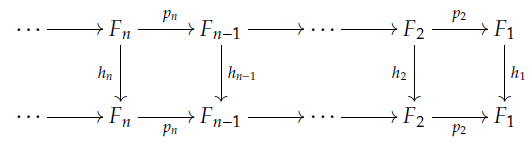


 Wild Topology