One of the infinite abelian groups that is important to infinite abelian group theory and which has shown up naturally in previous posts on infinitary fundamental groups is the Baer-Specker group, often just called the Specker group. This post isn’t all that topological, but I think it’s appropriate considering that infinite group theory is becoming increasingly important to this kind of infinite product-driven algebraic topology.
The Baer-Specker group is the countably infinite direct product of copies of the additive group of integers:

The elements* of the Specker group are sequences  of integers
  and addition is component-wise
  .
.
We’ll write  for the sequence whose only non-zero component is a
  in the n-th position. The countable set
  forms a basis for the free abelian subgroup
  consisting of the sequences
  that terminate in
  ‘s.
‘s.
But the Specker group  is uncountable (as is any countably infinite product of sets with cardinality
  ), which means the set
  cannot generate the whole group – equivalently is proper.
So is  a free abelian group or not?
On the face of it, the answer is not obvious. We answered the same question (with a negative answer) for the earring group  in a two-part post (Part I and Part II). This question about the Specker group is a bit easier since it is an abelian group with simpler combinatorial structure. In this post, I’ll walk through a nice, direct proof of the following theorem.
Theorem 1: is not a free group.
You’ll notice the argument is similar in spirit to the argument used to show is not free: basically, we’ll assume the group is free and exploit the infinite structure to find an integer which has infinitely many divisors – something which obviously can’t happen.
*It is also common to view the Specker group as the group  of functions
  from the natural numbers to integers.
History
Apparently, Reinhold Baer [1] first proved Theorem 1 in 1937 (or at least stronger results that imply it). Ernst Specker [3] re-proved this result among a number of other original results about . So the foundational theory of is often attributed to Specker as well. The proof I’m using in this post is a nice one from the AMM [2].
Free abelian groups and divisibility
First, let’s review some terminology.
Recall that a basis for an abelian group  is a subset
  such that every element
  can be written uniquely as a linear combination
  where
where  for all but finitely many
  . An abelian group is free if such a basis exists.
We will use the following elementary fact about free abelian groups.
Lemma 2: Suppose is a free abelian group with basis  ,
,  is a subset, and
  is the free subgroup generated with basis
  . The quotient
  is a free abelian group for which the set of cosets
  form a basis.
Also, we’ll deal with some divisibility issues.
If is an abelian group, a non-zero element, then we say a natural number  divides
  if
if

for some  . We call a divisor of and will be interested in cases when an element has finitely or infinitely many divisors. For example, every integer
  obviously has only finitely many divisors (using prime decomposition) but every non-zero rational number
  has infinitely many divisors since
  for every
  .
.
Lemma 3: Every non-zero element of a free abelian group has only finitely many divisors.
Proof. Suppose is a free abelian group with basis and is non-zero. Write uniquely using the basis. Fix some non-zero coefficient  such that
  . Notice that if divides , then
  for some
  . But this means is equal to both
 and
and  .
.
By the uniqueness of the representation of in the given basis  is equal to
  for some .
We have just argued that whenever divides , then also divides the integer . Since integers only have finitely many divisors, can only have finitely many divisors. 
The Specker group is not free
Proof of Theorem 1. Suppose  is a free abelian group with basis
  . Since
  is uncountable, the indexing set
  must also be uncountable.
Write each element  as a finite linear combination
  of basis elements. For fixed , let
  so that
  is the set of indices which has non-zero coefficient for some element
  . Notice that
  is countable since it is the countable union of finite sets
  . This means the free abelian subgroup
  generated by the basis
  is also countable.
Remark: It is worthwhile to point out that we have constructed  to be the smallest free subgroup (generated by our basis) containing all of the sequences .
Here are a few important observations:
 since
since  for each .
- Since is uncountable, the complement
 is also uncountable. Therefore the quotient group
  is uncountable.
- By Lemma 2, is a free abelian group with basis
 .
.
Definition: Let’s say a sequence  is multiplicative if for each , each quotient
  of consecutive terms is an integer not equal to
  (automatically this means
  for any ). Let
  be the set of multiplicative sequences.
For example,  and
and  are multiplicative. Let’s quickly convince ourselves that there are uncountably many multiplicative sequences.
Lemma 4: There are uncountably many multiplicative sequences in .
Proof. Consider the set of sequences  . Obviously this set is uncountable since, for instance, it contains the uncountable subset
  . Define a function
  by
by  . Clearly
  is an injection and since has an uncountable subset, must be uncountable.
Since  is uncountable and
  is countable, there exists some multiplicative sequence
  such that
  .
.
Recall that and so we have
 for each .
Since  is multiplicative, the element
 ,
,
where the first non-zero term is in the n+1-st position, is a well-defined element of the Specker group. Notice that

So in the free abelian group , we have  for all
  showing that
  has infinitely many divisors
  in . But according to Lemma 3, this cannot happen in a free abelian group so we obtain a contradiction.
This concludes the proof that is not free.
How is all this related to the earring group?
In an earlier post, I wrote up a proof of the fact that was not a free (non-abelian) group. The argument was similar the one above for the Specker group but was a bit more sophisticated. Actually, we proved a stronger fact:
Let ![g_n=[\ell_n]\in\pi_1(\mathbb{E})](https://s0.wp.com/latex.php?latex=g_n%3D%5B%5Cell_n%5D%5Cin%5Cpi_1%28%5Cmathbb%7BE%7D%29&bg=ffffff&fg=333333&s=0&c=20201002) be the homotopy class of the loop
be the homotopy class of the loop  which traverses the n-th circle of the earring space once in the counterclockwise direction.
Fact: The homomorphism  to the Specker group given by
  is injective and has image .
Neither identifying the image of  nor proving injectivity of is easy business. See this post if you’re looking for the proof.
Viewing  as the infinite wedge
  of circles as a subspace of the infinite torus
  , the inclusion map
  induces the surjective homomorphism
  to the Specker group. Another way to think about this map is that the n-th component of
 ![\epsilon([\alpha])](https://s0.wp.com/latex.php?latex=%5Cepsilon%28%5B%5Calpha%5D%29&bg=ffffff&fg=333333&s=0&c=20201002) is the winding number of
is the winding number of  around the n-th circle. For example,
  and
and ![\epsilon([\ell_1\ell_2\ell_3...])=(1,1,1,...)](https://s0.wp.com/latex.php?latex=%5Cepsilon%28%5B%5Cell_1%5Cell_2%5Cell_3...%5D%29%3D%281%2C1%2C1%2C...%29&bg=ffffff&fg=333333&s=0&c=20201002) .
.
In a similar way, let’s define a homomorphism
 , by
, by 
and prove the analogous theorem.
Theorem 5: The homomorphism given by  is injective and has image . Consequently,
  is countable.
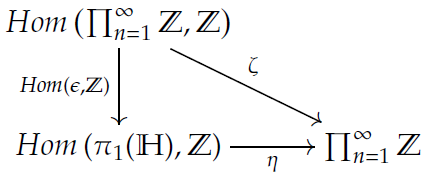
Proof. Since for each , the following diagram commutes:

Since  is surjective,
  is injective. Since both and are injective, so is
  . Also
  (since the triangle commutes). For each , let
  ,
,  be the projection onto the n-th coordinate. Then
  showing that
  .
.
Theorem 5 implies Theorem 1: The fact that is countable gives another proof that the Specker group is not free since if it the Specker group is free with (necessarily uncountable) basis , then the group

of all functions  is uncountable.
This viewpoint using the earring group should not be considered an easier proof of Theorem 1 since the hard work is still present on the non-abelian side. On the other hand, exploring the relationship between the two “non-freeness” results – namely that the non-abelian version implies the abelian one – is worth looking at.
References.
[1] R. Baer, Abelian groups without elements of finite order, Duke Math. J. 3 (1937) 68-122.
[2] S. Schroer, Baer’s Result: The infinite product of the integers has no basis, The American Mathematical Monthly 115, No. 7 (2008), 660-663.
[3] E. Specker, Additive Gruppen von Folgen ganzer Zahlen, Port. Math. 9 (1949) 131-140.
I found Specker’s paper freely available here but disappointingly, couldn’t get access to Baer’s paper without using my University library.


 , the
, the ![\displaystyle CX=\frac{X\times [0,1]}{X\times \{1\}}](https://s0.wp.com/latex.php?latex=%5Cdisplaystyle+CX%3D%5Cfrac%7BX%5Ctimes+%5B0%2C1%5D%7D%7BX%5Ctimes+%5C%7B1%5C%7D%7D&bg=ffffff&fg=333333&s=0&c=20201002) . The image of
. The image of  is the vertex
  of the cone and the (homeomorphic) image of
  is the base of the cone. Every cone
  is contractible (to the vertex point of the cone) and consequently has a trivial fundamental group.
 and
and  is the image of
  in the base of the cone
  . Let’s call this space the twin cone over
  by adjoining two cones at their vertices, then yes, we’d get back a contractible space. But the cone does not necessarily contract onto
  be the usual
  . The Griffiths twin cone, denoted
  is the twin cone
  over the earring space.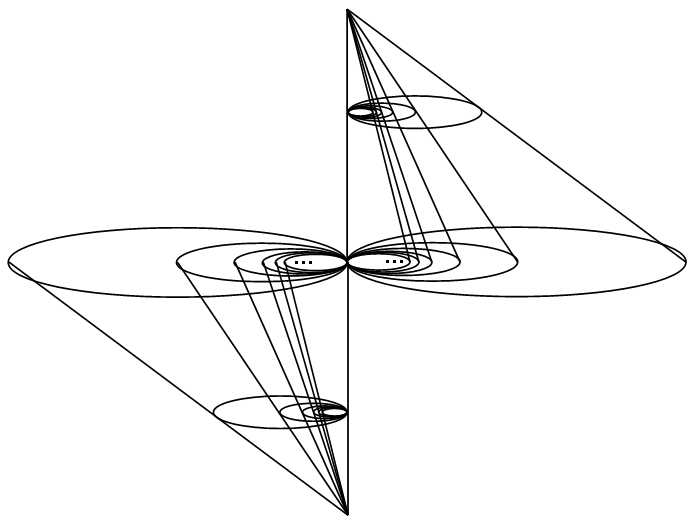
 which is clearly homeomorphic to
  be the circle of radius
  centered at
  . Now view these circles and their union
  in the xy-plane of
  .
. and
and  .
. be the union of all line segments from
  to
to  .
. .
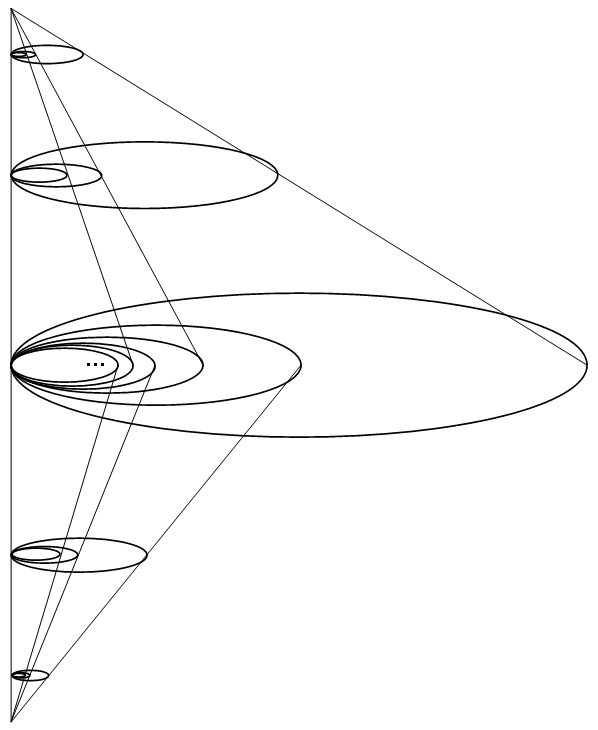
. . The Griffiths twin cone is the union
  with basepoint
  .
.
 :
:![\ell_n:[0,1]\to C_n\subset\mathbb{G}](https://s0.wp.com/latex.php?latex=%5Cell_n%3A%5B0%2C1%5D%5Cto+C_n%5Csubset%5Cmathbb%7BG%7D&bg=ffffff&fg=333333&s=0&c=20201002) be the circle which traverses
be the circle which traverses ![[\ell_n]](https://s0.wp.com/latex.php?latex=%5B%5Cell_n%5D&bg=ffffff&fg=333333&s=0&c=20201002) is the identity element
is the identity element  .
. is any finite set of integers and
  , then
 ![[\alpha]=1](https://s0.wp.com/latex.php?latex=%5B%5Calpha%5D%3D1&bg=ffffff&fg=333333&s=0&c=20201002) for any loop
for any loop ![\alpha:[0,1]\to\mathbb{G}](https://s0.wp.com/latex.php?latex=%5Calpha%3A%5B0%2C1%5D%5Cto%5Cmathbb%7BG%7D&bg=ffffff&fg=333333&s=0&c=20201002) with image in
with image in  .
. contains all even or all odd integers. Then
  is homeomorphic to the cone on the earring space and is therefore contractible. This means we have
  , even if it has image in infinitely many distinct cones.
 defined as
 ![\left[\frac{n-1}{n},\frac{n}{n+1}\right]](https://s0.wp.com/latex.php?latex=%5Cleft%5B%5Cfrac%7Bn-1%7D%7Bn%7D%2C%5Cfrac%7Bn%7D%7Bn%2B1%7D%5Cright%5D&bg=ffffff&fg=333333&s=0&c=20201002) and
and  . This loop winds around infinitely many even circles and infinitely many odd circles in an alternating fashion. Obviously, we can contract any finite number of these loops, showing that
  for any
  such that
  is path connected and contains the basepoint
  . If
. If  is simply connected, then
  where
where  is the conjugate closure of the image
  of the homomorphism induced by inclusion.
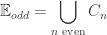 be the odd circle of the earring space and
  be the even circles. Both of these subspaces are still homeomorphic to
  and
and 
 induces a surjection
  of fundamental groups. Moreover,
  is the conjugate closure of
  .
. ,
,  and
and  .
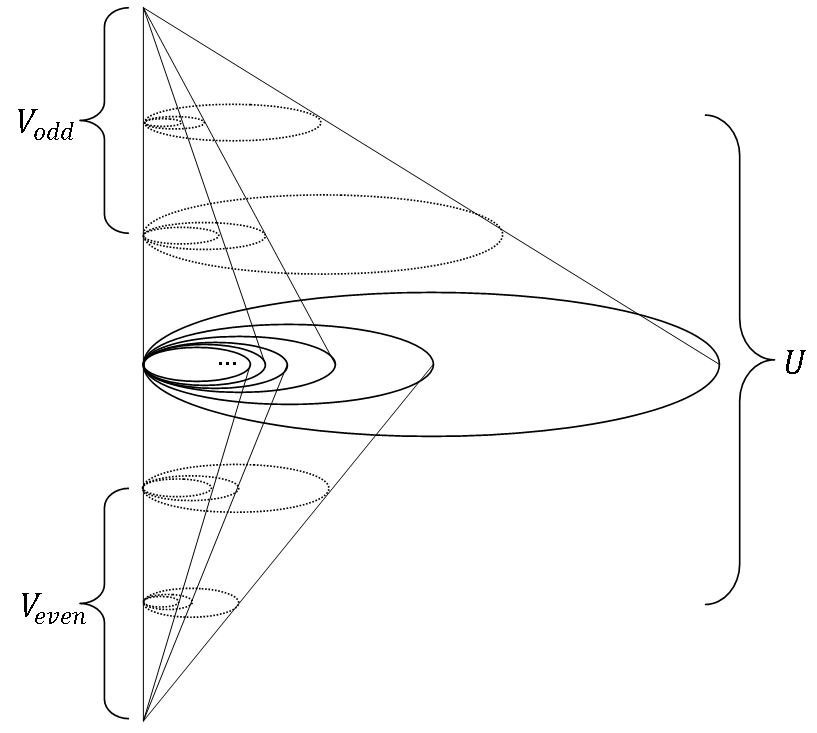
.
 ,
, ,
,  , and
, and  are path connected,
 deformation retracts onto
  ,
, is path connected and deformation retracts onto
  . This means the inclusion
  induces the canonical homomorphism
  .
. is path connected and deformation retracts onto
  . This means the inclusion
  induces the canonical homomorphism
  .
. and then to
  .
. where
where  , i.e. the conjugate closure of the image
  of the homomorphism on fundamental groups induced by the inclusion
  . Since
  where
where  is the conjugate closure of the image of the homomorphism
  induced by the inclusion
  .
.

 is surjective.
 . By our observations above, any loop with image entirely in
  is trivial. This means that
  .
. and
and  be the surjections induced by inclusion that compose to give
  and
and  . Thus
  . Recall that
  . Therefore if
  , then
  is of the form
![a(\ell_{1}^{-1}k_1\ell_1\ell_{2}^{-1}k_2\ell_2...\ell_{n}^{-1}k_n\ell_n)=[h_{1}^{-1}a(k_1)h_{1}][h_{2}^{-1}a(k_2)h_{2}]...[h_{n}^{-1}a(k_n)h_{n}]](https://s0.wp.com/latex.php?latex=a%28%5Cell_%7B1%7D%5E%7B-1%7Dk_1%5Cell_1%5Cell_%7B2%7D%5E%7B-1%7Dk_2%5Cell_2...%5Cell_%7Bn%7D%5E%7B-1%7Dk_n%5Cell_n%29%3D%5Bh_%7B1%7D%5E%7B-1%7Da%28k_1%29h_%7B1%7D%5D%5Bh_%7B2%7D%5E%7B-1%7Da%28k_2%29h_%7B2%7D%5D...%5Bh_%7Bn%7D%5E%7B-1%7Da%28k_n%29h_%7Bn%7D%5D&bg=ffffff&fg=333333&s=0&c=20201002)
 and
and  . Notice
  lies in the conjugate closure of
  . Thus
  which is the conjugate closure of
  . Thus
  is an element of the coset
  . This concludes the proof that
  .
.  , we have a smaller copy
  of the earring space that we can view as a subspace of
 ![\beta:[0,1]\to\mathbb{E}_{\geq m}](https://s0.wp.com/latex.php?latex=%5Cbeta%3A%5B0%2C1%5D%5Cto%5Cmathbb%7BE%7D_%7B%5Cgeq+m%7D&bg=ffffff&fg=333333&s=0&c=20201002) for every
for every ![\gamma:[0,1]\to\mathbb{E}](https://s0.wp.com/latex.php?latex=%5Cgamma%3A%5B0%2C1%5D%5Cto%5Cmathbb%7BE%7D&bg=ffffff&fg=333333&s=0&c=20201002) . According to our study of the earring group (in the
. According to our study of the earring group (in the  is homotopic to a finite concatenation of loops each of which has image in either
  or
or  . But we observed above that any loop in
  . Consequently,
  that sends
 ![\phi([\ell_n])=1](https://s0.wp.com/latex.php?latex=%5Cphi%28%5B%5Cell_n%5D%29%3D1&bg=ffffff&fg=333333&s=0&c=20201002) for all
for all  is any homomorphism, then
  must be trivial. Since
 ![\{[\ell_n]\in\pi_1(\mathbb{E})|n\geq 1\}\subset G_{odd}\cup G_{even}](https://s0.wp.com/latex.php?latex=%5C%7B%5B%5Cell_n%5D%5Cin%5Cpi_1%28%5Cmathbb%7BE%7D%29%7Cn%5Cgeq+1%5C%7D%5Csubset+G_%7Bodd%7D%5Ccup+G_%7Beven%7D&bg=ffffff&fg=333333&s=0&c=20201002) , however, this quotient is “too big” since, to get
, however, this quotient is “too big” since, to get  . This, in my opinion, makes dealing with
  . For instance, if
  such that
 ![f([\ell_n])=1](https://s0.wp.com/latex.php?latex=f%28%5B%5Cell_n%5D%29%3D1&bg=ffffff&fg=333333&s=0&c=20201002) for all
for all  is uncountable (though I have heard by word of mouth that this is true).
 Wild Topology