In this last post about reduced paths, I’m going to work through the details of one of the most useful results in wild topology. Writing this post helped me work out my own way of proving this result and hopefully will help bring together some ideas from the literature in a unique way in a way that is helpful to folks trying to learn about some of the techniques of the field.
Unique Reduced Path Theorem: If  is a one-dimensional Hausdorff space, then every path
 ![\alpha:[0,1]\to X](https://s0.wp.com/latex.php?latex=%5Calpha%3A%5B0%2C1%5D%5Cto+X&bg=ffffff&fg=333333&s=0&c=20201002) is path-homotopic to a reduced path
is path-homotopic to a reduced path ![\beta:[0,1]\to X](https://s0.wp.com/latex.php?latex=%5Cbeta%3A%5B0%2C1%5D%5Cto+X&bg=ffffff&fg=333333&s=0&c=20201002) that is unique up to reparameterization. Moreover, the homotopy between
that is unique up to reparameterization. Moreover, the homotopy between  and
and  has image in
  .
.
Although stated a little differently, this was basically proven in [2]. The contemporary version appears in [1]. This theorem changed the game for me. Instead of using inverse limits all of the time, this allowed me to understand and prove things using order theory and unique reduced representatives.
First, it might be helpful to give more explanation of the statement itself.
- What does one-dimensional mean? Actually, you can use any of the three standard notions of dimension (Lebesgue covering, small inductive, or large inductive) and this theorem would still be true. Generally, Lebesgue covering dimension is the typical choice.
- Recall from Part I that a path being reduced means that has no null-homotopic subloops, i.e. there is no
![[a,b]\subseteq [0,1]](https://s0.wp.com/latex.php?latex=%5Ba%2Cb%5D%5Csubseteq+%5B0%2C1%5D&bg=ffffff&fg=333333&s=0&c=20201002) such that
such that ![\beta|_{[a,b]}](https://s0.wp.com/latex.php?latex=%5Cbeta%7C_%7B%5Ba%2Cb%5D%7D&bg=ffffff&fg=333333&s=0&c=20201002) is a null-homotopic loop.
is a null-homotopic loop.
- What does “unique up to reparameterization” mean? A path
![\beta:[a,b]\to X](https://s0.wp.com/latex.php?latex=%5Cbeta%3A%5Ba%2Cb%5D%5Cto+X&bg=ffffff&fg=333333&s=0&c=20201002) is a reparameterization of a path
is a reparameterization of a path ![\gamma:[c,d]\to X](https://s0.wp.com/latex.php?latex=%5Cgamma%3A%5Bc%2Cd%5D%5Cto+X&bg=ffffff&fg=333333&s=0&c=20201002) if there is an increasing homeomorphism
if there is an increasing homeomorphism ![h:[c,d]\to [a,b]](https://s0.wp.com/latex.php?latex=h%3A%5Bc%2Cd%5D%5Cto+%5Ba%2Cb%5D&bg=ffffff&fg=333333&s=0&c=20201002) such that
such that  . I use the notation
  when this occurs. Reparameterization is an equivalence relation on the set of paths in a space. So “unique up to reparameterization” means that if and are homotopic reduced paths in a 1-dim. space, then
  .
.
- The last statement of the theorem implies that deforming to its reduced representative only requires deleting portions of . As a special case, if is a null-homotopic loop, then it contracts in its own image.
One-dimensional Peano continua
We need to dive into some terminology and “well-known” results from General Topology here. I’ve used these terms and results before but here’s a reminder:
An arc (respectively, simple closed curve) in a space is a subspace of that is homeomorphic to ![[0,1]](https://s0.wp.com/latex.php?latex=%5B0%2C1%5D&bg=ffffff&fg=333333&s=0&c=20201002) (respectively,
(respectively,  ). If
). If ![h:[0,1]\to X](https://s0.wp.com/latex.php?latex=h%3A%5B0%2C1%5D%5Cto+X&bg=ffffff&fg=333333&s=0&c=20201002) is an embedding onto the arc
is an embedding onto the arc ![A=h([0,1])](https://s0.wp.com/latex.php?latex=A%3Dh%28%5B0%2C1%5D%29&bg=ffffff&fg=333333&s=0&c=20201002) , we call
, we call  and
and  the endpoints of the arc. Notice that an “arc” is technically not the same thing as an embedding
 ![[0,1]\to X](https://s0.wp.com/latex.php?latex=%5B0%2C1%5D%5Cto+X&bg=ffffff&fg=333333&s=0&c=20201002) . Rather an arc is the image of such an embedding with the subspace topology.
. Rather an arc is the image of such an embedding with the subspace topology.
A space is uniquely arcwise connected, if given any distinct  , there is a unique arc
  with endpoints
  and
and  .
.
A Peano continuum is a connected, locally path-connected compact metric space. The Hahn-Mazurkiewicz Theorem says that a space is a Peano continuum if and only if is Hausdorff and there exists a continuous surjection .
A dendrite is a Peano continuum that has no simple closed curves. I go into some of the theory of dendrites in this old post on shape injectivity. In particular, I mention a well-known structure theorem, which says that a dendrite  is homeomorphic to an inverse limit
  of trees
  where
where  is with a single edge attached and each bonding map
  collapses that edge to the vertex at which it is attached. In Part II of the Shape Injectivity Post, we used this structure theorem to prove that dendrites are contractible.
To put these old posts to work here’s a theorem that I mentioned at the end of Part II.
Inverse Limit Representation Theorem [3, Theorem 1]: Every one-dimensional path-connected compact metric space can be written as an inverse limit  of finite graphs
  .
.
In fact, this is improved a bit in [4] where it is shown that it is possible to improve a given inverse system to ensure that all bonding maps  map
map  surjectively and simplicially onto some finite subdivision of .
Dendrite Factorization Lemma
The next lemma is at the heart of why we can do so much in wild one-dimensional spaces like the earring space, Menger Cube, and higher-dimensional constructions that start with one-dimensional spaces, e.g. the Harmonic Archipelago. The proof for a general space  is the same as that for loops where
  so I went ahead and wrote out the general proof.
Lemma: If is a one-dimensional Hausdorff space, is a Peano continuum, and  is a null-homotopic map based at
  , then factors through a dendrite, that is, there is a dendrite a map
  and a map
  such that
  .
.
Proof. Assuming that is non-constant, notice that is one-dimensional and Hausdorff (as a subspace of a one-dimensional Hausdorff space that admits a non-constant path). Since is a Hausdorff continuous image of a Peano continuum, it is a Peano continuum by the Hahn-Mazurkiewicz Theorem. Hence, we may assume that  and that is a Peano continuum.
Using the Inverse Limit Representation Theorem, write  with bonding maps
  and finite graphs . If
  are the projections, we take
  to be the basepoints in the graphs. Let
  be the universal covering map where is a tree. As we did in Part II of the Shape Injectivity Post, once we choose basepoints
  , the maps
  induce unique based maps
  that give the following inverse system of covering maps.

Since is null-homotopic in and each latex  is a Hurewicz fibration, the map
  is null-homotopic in the graph and has a unique lift to a based map
  . These based lifts agree with the bonding maps
  and give the inverse system of covering maps you see below. The universal property of inverse limits gives a unique map
  based at
  such that.
  . In fact, Hurewicz fibrations are closed under inverse limits so
  is also a Hurewicz fibration!

Let  . Since the inverse limit of trees is clearly Hausdorff, is a Peano continuum. Moreover, I gave a detailed proof in Part I of the Shape Injectivity Post that an inverse limit of trees contains no simple closed curves. Since is a Peano continuum with no simple closed curves, it must be a dendrite! Taking
  to be the restriction of to , completes the proof.
We could replace with any Peano continuum in the next Corollary, but I’ll try to keep it focused.
Corollary: Every null-homotopic loop  in a one-dimensional Hausdorff space contracts in its own image.
Proof. Suppose  is a null-homotopic map. By the previous Lemma, we have
  for a map
  and map
  where is a dendrite. Set
  . Since is contractible, there is a null-homotopy latex
 ![H:S^1\times [0,1] \to D](https://s0.wp.com/latex.php?latex=H%3AS%5E1%5Ctimes+%5B0%2C1%5D+%5Cto+D&bg=ffffff&fg=333333&s=0&c=20201002) with
with  ,
,  . Now
. Now  is a null-homotopy of .
The null-homotopy  in the last proof is a “free” null-homotopy but since is well-pointed, you could just as easily construct a basepoint-preserving homotopy.
Getting back on track, we’d like to apply the general results in Part II, which says that homotopy classes of paths will have reduced representatives if our space has well-defined transfinite  -products. So let’s make sure that happens.
Proposition: Every one-dimensional Hausdorff space has well-defined transfinite -products.
Proof. Let be a one-dimensional Hausdorff space. Suppose ![A\subseteq [0,1]](https://s0.wp.com/latex.php?latex=A%5Csubseteq+%5B0%2C1%5D&bg=ffffff&fg=333333&s=0&c=20201002) is a closed set containing
is a closed set containing  and
and ![\alpha,\beta:[0,1]\to X](https://s0.wp.com/latex.php?latex=%5Calpha%2C%5Cbeta%3A%5B0%2C1%5D%5Cto+X&bg=ffffff&fg=333333&s=0&c=20201002) are paths such that
are paths such that  and such that for every connected component
  of
of ![[0,1]\backslash A](https://s0.wp.com/latex.php?latex=%5B0%2C1%5D%5Cbackslash+A&bg=ffffff&fg=333333&s=0&c=20201002) , we have
, we have  . We must show that
  . For each component of , the loop
  is null-homotopic and therefore (by the last Corollary) contracts by a null-homotopy in
  . In particular, there exists an endpoint-relative homotopy
 ![H_{I}:\overline{J}\times [0,1]\to X](https://s0.wp.com/latex.php?latex=H_%7BI%7D%3A%5Coverline%7BJ%7D%5Ctimes+%5B0%2C1%5D%5Cto+X&bg=ffffff&fg=333333&s=0&c=20201002) , where
, where
We just need to put these all together! Define ![H:[0,1]^2\to X](https://s0.wp.com/latex.php?latex=H%3A%5B0%2C1%5D%5E2%5Cto+X&bg=ffffff&fg=333333&s=0&c=20201002) by
by
![H(s,t)=\begin{cases} \alpha(s), & \text{ if }s\in A, \\ H_J(s,t), & \text{ if }s\in J\text{ for a component }J\text{ of }[0,1]\backslash A \end{cases}](https://s0.wp.com/latex.php?latex=H%28s%2Ct%29%3D%5Cbegin%7Bcases%7D+%5Calpha%28s%29%2C%C2%A0+%26+%5Ctext%7B+if+%7Ds%5Cin+A%2C+%5C%5C+H_J%28s%2Ct%29%2C+%26+%5Ctext%7B+if+%7Ds%5Cin+J%5Ctext%7B+for+a+component+%7DJ%5Ctext%7B+of+%7D%5B0%2C1%5D%5Cbackslash+A+%5Cend%7Bcases%7D&bg=ffffff&fg=333333&s=0&c=20201002)
Notice that ![H|_{A\times[0,1]}](https://s0.wp.com/latex.php?latex=H%7C_%7BA%5Ctimes%5B0%2C1%5D%7D&bg=ffffff&fg=333333&s=0&c=20201002) is the constant homotopy at .
is the constant homotopy at .
Checking continuity of
would be considered “routine” for those who make these constructions a lot so sometimes these things are skipped in the literature. But a blog is a good place to lay out the details for those who are still getting used to the proof techniques. So let’s do it!
Fix ![(s,t)\in [0,1]^2](https://s0.wp.com/latex.php?latex=%28s%2Ct%29%5Cin+%5B0%2C1%5D%5E2&bg=ffffff&fg=333333&s=0&c=20201002) and an open neighborhood
and an open neighborhood  of
of  in . Since each
  is continuous, is continuous at
  if
if  for some component of . So we may assume
  . Since and are continuous at
  , there exists
  such that
 ![\alpha([s-\delta,s+\delta])\cup \beta([s-\delta,s+\delta])\subseteq U](https://s0.wp.com/latex.php?latex=%5Calpha%28%5Bs-%5Cdelta%2Cs%2B%5Cdelta%5D%29%5Ccup+%5Cbeta%28%5Bs-%5Cdelta%2Cs%2B%5Cdelta%5D%29%5Csubseteq+U&bg=ffffff&fg=333333&s=0&c=20201002) . We now have
. We now have ![H([([s-\delta,s+\delta]\cap A)\times [0,1])=\alpha([s-\delta,s+\delta]\cap A)\subseteq U](https://s0.wp.com/latex.php?latex=H%28%5B%28%5Bs-%5Cdelta%2Cs%2B%5Cdelta%5D%5Ccap+A%29%5Ctimes+%5B0%2C1%5D%29%3D%5Calpha%28%5Bs-%5Cdelta%2Cs%2B%5Cdelta%5D%5Ccap+A%29%5Csubseteq+U&bg=ffffff&fg=333333&s=0&c=20201002) . If
. If ![J\subseteq [s-\delta,s+\delta]](https://s0.wp.com/latex.php?latex=J%5Csubseteq+%5Bs-%5Cdelta%2Cs%2B%5Cdelta%5D&bg=ffffff&fg=333333&s=0&c=20201002) , then
, then ![H(\overline{J}\times [0,1])=Im(H_J)\subseteq \alpha(\overline{J})\cup\beta(\overline{J})\subseteq U](https://s0.wp.com/latex.php?latex=H%28%5Coverline%7BJ%7D%5Ctimes+%5B0%2C1%5D%29%3DIm%28H_J%29%5Csubseteq+%5Calpha%28%5Coverline%7BJ%7D%29%5Ccup%5Cbeta%28%5Coverline%7BJ%7D%29%5Csubseteq+U&bg=ffffff&fg=333333&s=0&c=20201002) by the definition of . What remains is to consider components having as an endpoint.
by the definition of . What remains is to consider components having as an endpoint.
If is not an endpoint of a component of , then we may find  such that
 ![s\in (c,d)\subseteq [s-\delta,s+\delta]](https://s0.wp.com/latex.php?latex=s%5Cin+%28c%2Cd%29%5Csubseteq+%5Bs-%5Cdelta%2Cs%2B%5Cdelta%5D&bg=ffffff&fg=333333&s=0&c=20201002) . If is a right endpoint of a component latex
. If is a right endpoint of a component latex  , then we may choose
  small enough so that
 ![H((c,s]\times[0,1])=H_J((c,s]\times[0,1])\subseteq U](https://s0.wp.com/latex.php?latex=H%28%28c%2Cs%5D%5Ctimes%5B0%2C1%5D%29%3DH_J%28%28c%2Cs%5D%5Ctimes%5B0%2C1%5D%29%5Csubseteq+U&bg=ffffff&fg=333333&s=0&c=20201002) (by the continuity of ). Similarly, if is a left endpoint of a component
(by the continuity of ). Similarly, if is a left endpoint of a component  , then we may choose
  small enough so that
 ![H([s,d)\times[0,1])=H_{J'}([s,d)\times[0,1])\subseteq U](https://s0.wp.com/latex.php?latex=H%28%5Bs%2Cd%29%5Ctimes%5B0%2C1%5D%29%3DH_%7BJ%27%7D%28%5Bs%2Cd%29%5Ctimes%5B0%2C1%5D%29%5Csubseteq+U&bg=ffffff&fg=333333&s=0&c=20201002) . In any case, we can find an open interval
. In any case, we can find an open interval  of such that
 ![H((c,d)\times[0,1])\subseteq U](https://s0.wp.com/latex.php?latex=H%28%28c%2Cd%29%5Ctimes%5B0%2C1%5D%29%5Csubseteq+U&bg=ffffff&fg=333333&s=0&c=20201002) .
.
The main point of Part II, was to show that every path in a Hausdorff space with well-defined transfinite -products is path-homotopic to a reduced path. This path-homotopy was defined by “deleting” null-homotopic subloops on a maximal cancellation and therefore had image in the image of . Combining this old stuff with the above proposition, it must be that every path in a one-dimensional Hausdorff space is path-homotopic to a reduced path by a homotopy that takes place in the image of that path itself. This proves the existence portion of the Unique Reduced Path Theorem as well as the last statement about the size of the homotopy required.
Uniqueness of reduced paths in one-dimensional spaces
Dendrites have their infinitely many little fingers all over this content. We’ll need them again to finish the proof of uniqueness.
Lemma: If is a one-dimensional Hausdorff space and are reduced and path-homotopic to each other, then , i.e. there exists an increasing homeomorphism ![h:[0,1]\to [0,1]](https://s0.wp.com/latex.php?latex=h%3A%5B0%2C1%5D%5Cto+%5B0%2C1%5D&bg=ffffff&fg=333333&s=0&c=20201002) such that
such that  .
.
Proof. By replacing with the image of a homotopy from to , we may assume that is a Peano continuum. Now  is a null-homotopic loop and so by Dendrite factorization, there exists a dendrite , a loop
 ![\gamma:[0,1]\to D](https://s0.wp.com/latex.php?latex=%5Cgamma%3A%5B0%2C1%5D%5Cto+D&bg=ffffff&fg=333333&s=0&c=20201002) , and a map such that
, and a map such that  . Write
  so that
  and
and  . Let
. Let  and
and  . Recall that dendrites are uniquely arcwise connected and so there is a unique arc
  in with endpoints
  and
and  . Now
. Now  is a path in from to . We check that is injective and therefore a parameterization of . If
  such that
  , then
 ![(\gamma_1)|_{[a,b]}](https://s0.wp.com/latex.php?latex=%28%5Cgamma_1%29%7C_%7B%5Ba%2Cb%5D%7D&bg=ffffff&fg=333333&s=0&c=20201002) would be a loop. Since dendrites are contractible, is a null-homotopic loop. Then
would be a loop. Since dendrites are contractible, is a null-homotopic loop. Then ![\alpha|_{[a,b]}=f\circ(\gamma_1)|_{[a,b]}](https://s0.wp.com/latex.php?latex=%5Calpha%7C_%7B%5Ba%2Cb%5D%7D%3Df%5Ccirc%28%5Cgamma_1%29%7C_%7B%5Ba%2Cb%5D%7D&bg=ffffff&fg=333333&s=0&c=20201002) must also be a null-homotopic loop. However, this violates the assumption that is reduced. Since is also reduced, applying the same argument to
must also be a null-homotopic loop. However, this violates the assumption that is reduced. Since is also reduced, applying the same argument to  shows that also parameterizes . Since both
 ![\gamma_1,\gamma_2:[0,1]\to A](https://s0.wp.com/latex.php?latex=%5Cgamma_1%2C%5Cgamma_2%3A%5B0%2C1%5D%5Cto+A&bg=ffffff&fg=333333&s=0&c=20201002) are homeomorphisms with the same orientation, we consider the increasing homeomorphism
are homeomorphisms with the same orientation, we consider the increasing homeomorphism ![h=\gamma_{2}^{-}\circ\gamma_{1}:[0,1]\to [0,1]](https://s0.wp.com/latex.php?latex=h%3D%5Cgamma_%7B2%7D%5E%7B-%7D%5Ccirc%5Cgamma_%7B1%7D%3A%5B0%2C1%5D%5Cto+%5B0%2C1%5D&bg=ffffff&fg=333333&s=0&c=20201002) . Now
. Now  , which completes the proof. .
What’s the Takeaway?
Imagine you’ve got a based loop where is the earring space or, more amazingly, the Menger cube. The homotopy class ![[\alpha]](https://s0.wp.com/latex.php?latex=%5B%5Calpha%5D&bg=ffffff&fg=333333&s=0&c=20201002) in the fundamental group is represented by a “tightest” loop that has absolutely no homotopical redundancy. Every point
in the fundamental group is represented by a “tightest” loop that has absolutely no homotopical redundancy. Every point  is crucial to that homotopy class and the order in which those points are traced out in is completely unique.
This also tells you about the operation in the fundamental groupoid  too. Suppose you’ve got two composable path-homotopy classes
  . Write
 ![g=[\alpha]](https://s0.wp.com/latex.php?latex=g%3D%5B%5Calpha%5D&bg=ffffff&fg=333333&s=0&c=20201002) and
and ![h=[\beta]](https://s0.wp.com/latex.php?latex=h%3D%5B%5Cbeta%5D&bg=ffffff&fg=333333&s=0&c=20201002) for reduced paths and . Then the product
for reduced paths and . Then the product  is represented by the concatenation
  . However, may not be reduced. But, it’s still homotopic to some reduced path
  and that reduced representative is obtained by deleting null-homotopic subloops on a maximal cancellation. But wait! There’s only one possible way for this to happen because the entirety of and are both reduced. A maximal cancellation of can only contain one interval, which must contain the concatenation point
  . Hence, there exists
  and
and  such that
 ![\alpha|_{[s,1]}\simeq \beta|_{[0,t]}^{-}](https://s0.wp.com/latex.php?latex=%5Calpha%7C_%7B%5Bs%2C1%5D%7D%5Csimeq+%5Cbeta%7C_%7B%5B0%2Ct%5D%7D%5E%7B-%7D&bg=ffffff&fg=333333&s=0&c=20201002) . There’s more! If a path is reduced, then all of its subpaths are reduced too. Since
. There’s more! If a path is reduced, then all of its subpaths are reduced too. Since ![\alpha|_{[s,1]}](https://s0.wp.com/latex.php?latex=%5Calpha%7C_%7B%5Bs%2C1%5D%7D&bg=ffffff&fg=333333&s=0&c=20201002) and
and ![\beta|_{[0,t]}^{-}](https://s0.wp.com/latex.php?latex=%5Cbeta%7C_%7B%5B0%2Ct%5D%7D%5E%7B-%7D&bg=ffffff&fg=333333&s=0&c=20201002) are homotopic reduced paths, which means they are actually reparameterizations of each other.
are homotopic reduced paths, which means they are actually reparameterizations of each other.
Theorem: Suppose
are reduced paths in a one-dimensional Hausdorff space satisfying

. Then either
is reduced or there exists unique
and
such that
![\alpha|_{[s,1]}\equiv \beta|_{[t,1]}^{-}](https://s0.wp.com/latex.php?latex=%5Calpha%7C_%7B%5Bs%2C1%5D%7D%5Cequiv+%5Cbeta%7C_%7B%5Bt%2C1%5D%7D%5E%7B-%7D&bg=ffffff&fg=333333&s=0&c=20201002)
and
![\alpha|_{[0,s]}\cdot\beta|_{[t,1]}](https://s0.wp.com/latex.php?latex=%5Calpha%7C_%7B%5B0%2Cs%5D%7D%5Ccdot%5Cbeta%7C_%7B%5Bt%2C1%5D%7D&bg=ffffff&fg=333333&s=0&c=20201002)
is a reduced path representing
![[\alpha][\beta]](https://s0.wp.com/latex.php?latex=%5B%5Calpha%5D%5B%5Cbeta%5D&bg=ffffff&fg=333333&s=0&c=20201002)
.
[1] J.W. Cannon, G.R. Conner, On the fundamental groups of one-dimensional spaces, Topology Appl. 153 (2006) 2648–2672.
[2] M.L. Curtis, M.K. Fort, Jr., The fundamental group of one-dimensional spaces, Proc. Amer. Math. Soc. 10 (1959) 140–148.
[3] Mardešic, S., Segal, J.,  –Mappings onto polyhedra. Trans. Am. Math. Soc. 109, 146–164 (1963)
[4] Rogers, J.W. Jr., Inverse limits on graphs and monotone mappings. Trans. Am. Math. Soc. 176, 215–225 (1973)




















![[[W]] = [[\textbf{Red}(\prod_{\lambda \in \text{p-index}(W) \setminus F}W_{\lambda})]]](https://s0.wp.com/latex.php?latex=%5B%5BW%5D%5D+%3D+%5B%5B%5Ctextbf%7BRed%7D%28%5Cprod_%7B%5Clambda+%5Cin+%5Ctext%7Bp-index%7D%28W%29+%5Csetminus+F%7DW_%7B%5Clambda%7D%29%5D%5D&bg=ffffff&fg=333333&s=0&c=20201002)
![[[\cdot]]](https://s0.wp.com/latex.php?latex=%5B%5B%5Ccdot%5D%5D&bg=ffffff&fg=333333&s=0&c=20201002)


![\varpropto(I, \iota) := \bigcup_{\lambda < \lambda'; \lambda, \lambda' \in \iota(I)} [\lambda, \lambda'] \subseteq \Lambda_1](https://s0.wp.com/latex.php?latex=%5Cvarpropto%28I%2C+%5Ciota%29+%3A%3D+%5Cbigcup_%7B%5Clambda+%3C+%5Clambda%27%3B+%5Clambda%2C+%5Clambda%27+%5Cin+%5Ciota%28I%29%7D+%5B%5Clambda%2C+%5Clambda%27%5D+%5Csubseteq+%5CLambda_1&bg=ffffff&fg=333333&s=0&c=20201002)










![[[U_{x_0} \upharpoonright_p \varpropto(I_0, \iota_{x_0})]] = [[(U_{x_1} \upharpoonright_p \varpropto(I_1, \iota_{x_1}))^i]]](https://s0.wp.com/latex.php?latex=%5B%5BU_%7Bx_0%7D+%5Cupharpoonright_p+%5Cvarpropto%28I_0%2C+%5Ciota_%7Bx_0%7D%29%5D%5D+%3D+%5B%5B%28U_%7Bx_1%7D+%5Cupharpoonright_p+%5Cvarpropto%28I_1%2C+%5Ciota_%7Bx_1%7D%29%29%5Ei%5D%5D&bg=ffffff&fg=333333&s=0&c=20201002)




![[[W_{x_2} \upharpoonright_p \varpropto(I_2, \iota_{x_2}^{-1})]] = [[(W_{x_3} \upharpoonright_p \varpropto(I_3, \iota_{x_3}^{-1}))^j]]](https://s0.wp.com/latex.php?latex=%5B%5BW_%7Bx_2%7D+%5Cupharpoonright_p+%5Cvarpropto%28I_2%2C+%5Ciota_%7Bx_2%7D%5E%7B-1%7D%29%5D%5D+%3D+%5B%5B%28W_%7Bx_3%7D+%5Cupharpoonright_p+%5Cvarpropto%28I_3%2C+%5Ciota_%7Bx_3%7D%5E%7B-1%7D%29%29%5Ej%5D%5D&bg=ffffff&fg=333333&s=0&c=20201002)


![[[U \upharpoonright_p \varpropto(I_0, \iota)]] = [[E]] = [[U \upharpoonright_p \varpropto(I_1, \iota)]]](https://s0.wp.com/latex.php?latex=%5B%5BU+%5Cupharpoonright_p+%5Cvarpropto%28I_0%2C+%5Ciota%29%5D%5D+%3D+%5B%5BE%5D%5D+%3D+%5B%5BU+%5Cupharpoonright_p+%5Cvarpropto%28I_1%2C+%5Ciota%29%5D%5D&bg=ffffff&fg=333333&s=0&c=20201002)


![[[U \upharpoonright_p \varpropto(I_0, \iota)]] = [[E]] = [[(U \upharpoonright_p \varpropto(I_1, \iota))^{-1}]]](https://s0.wp.com/latex.php?latex=%5B%5BU+%5Cupharpoonright_p+%5Cvarpropto%28I_0%2C+%5Ciota%29%5D%5D+%3D+%5B%5BE%5D%5D+%3D+%5B%5B%28U+%5Cupharpoonright_p+%5Cvarpropto%28I_1%2C+%5Ciota%29%29%5E%7B-1%7D%5D%5D&bg=ffffff&fg=333333&s=0&c=20201002)




![W\upharpoonright_p I \mapsto [[U\upharpoonright_p \varpropto (I, \iota)]]](https://s0.wp.com/latex.php?latex=W%5Cupharpoonright_p+I+%5Cmapsto+%5B%5BU%5Cupharpoonright_p+%5Cvarpropto+%28I%2C+%5Ciota%29%5D%5D&bg=ffffff&fg=333333&s=0&c=20201002)




 first appeared in print in H. B. Griffith’s paper The fundamental group of two spaces with a common point, Quart. J. Math. Oxford 2 (1954), 175-190. The first appearance of the harmonic archipelago
  seems to be in the work of W. A. Bogley and A. J. Sieradski Weighted combinatorial group theory and wild metric complexes, Groups-Korea ’98 (Pusan), de Gruyter, Berlin, 2000, 53-80. For more background into these two spaces, you can consult some of Brazas’ old blog posts:
  originated with James W. Cannon and Gregory R. Conner.
 is the shrinking wedge of countably infinitely many circles. More formally if
  we let
  denote the circle centered at
  of radius
  . The subspace
  is given by
  (
( will be like a free group. While this is true, it is emphasized that
  and
and  be a countably infinite collection of symbols, which we will call letters, which is equipped with formal inverses. Usually the superscript
  is not written. A word
  where the domain
  and
and  the set
  is finite). It follows that the domain
 given by
  (notice that each element of the alphabet
 is not a word since the letter
  is used infinitely often. Let
  : any finite-to-one function
  is a word. As a technical aside, we consider two words
  and
and  to be equivalent, and write
  , provided there exists an order isomorphism
  such that
  for all
  . We form the concatenation of two words
  , by declaring that
  with the elements in
  being ordered below those in
  and having
 indexed by
  , ordered in the natural way, and defined by
  where
where  . This function we denote
  and it is a word provided it is finite-to-one.
 , given by letting
  be the set
  . For example the inverse of the word
 and word
  be the finite word given by the restriction
  . Given words
  we write
  if for each
  the words
  and
and  are equal as elements in the free group. For example, the word
 ,
,  and for
  we get
 .
. . The binary operation is given by concatenation:
  and the
  .
. (either or both of which may be empty) such that
  . Moreover
  ) in the above writing is empty. Finally a word
  implies
  . Clearly every subword of a reduced word is itself reduced. The proof of the following result is far more difficult than that of the free group analogue:
 denote the reduced representative of the
  that
that  . Moreover, given reduced words
  there exist words
  such that
 ;
; ;
; ;
; is reduced.
 -products and noncommutatively slender groups, J. Algebra 148 (1992), 243-263.
 of reduced words with binary operation
  . We introduce two alphabets with formal inverses:
 (with
(with  (with
(with  and
and  denote the respective sets of reduced words. These two sets are each groups under the binary operation
  and the isomorphism with
  where
where  ).
). is
is  pure if the first subscript in each of the letters appearing in
  , and
, and  –pure is defined analogously. A word is
  -pure or
  every subword of a
  -pure word is again
  denote the set of
  is isomorphic to
  , where the notation
  denotes the smallest normal subgroup which includes the input. This isomorphism can be seen by two applications of van Kampen’s Theorem (see e.g. Section 4 in K. Eda, H. Fischer, Cotorsion-free groups from a topological viewpoint, Topology Appl. 214 (2016), 21-34.)
 –pure, where
  (i.e.
(i.e.  where
where  ). A word is
  denote the set of
  is isomorphic to
  (see Theorem 5 of G. R. Conner, W. Hojka, M. Meilstrup, Archipelago groups, Proc. Amer. Math. Soc. 143 (2015), 4973-4988.)
 induces a trivial homomorphism
  (using the fact that
  so that
  is surjective, it is not possible to make such an
  and
and  . We will continue in Part 2.
 ,
, ,
, and
and  ,
, .
.
![A\times [0,1]](https://s0.wp.com/latex.php?latex=A%5Ctimes+%5B0%2C1%5D&bg=ffffff&fg=333333&s=0&c=20201002) (shaded in blue). For components
(shaded in blue). For components ![\overline{J}\times [0,1]](https://s0.wp.com/latex.php?latex=%5Coverline%7BJ%7D%5Ctimes+%5B0%2C1%5D&bg=ffffff&fg=333333&s=0&c=20201002) (the white boxes).
(the white boxes).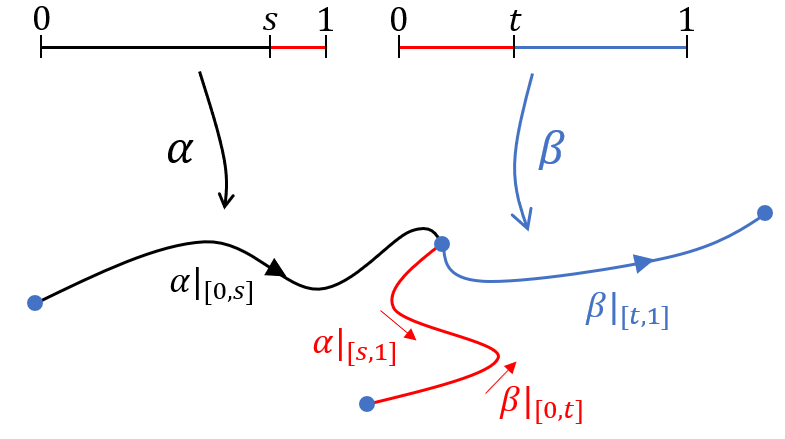
 Wild Topology