This is the last in a sequence of posts about the quotient topology. This one is about how the topological structure of can be used to classify certain generalizations of covering maps for locally complicated spaces. Sometimes it still amazes me how this works out. For a sneak peak, see the table at the end of the post.
Ordinary covering maps
One of the things we love about covering space theory is that covering spaces over a locally nice (path-connected, locally path connected, and semilocally simply connected) space are completely classified by the subgroups of . In particular, for every subgroup , there is a based covering map such that . Moreover, is unique up to based homeomorphism for given and the covering space can be built using a “standard construction.” In particular, if is the trivial subgroup, then is simply connected and we call a universal covering map.
Now, let’s say we drop the semilocally simply connectedness assumption. So is still path-connected and locally path connected but it’s not semilocally simply connected so there is some point in where arbitrarily small loops are not be null-homotopic. In this case, won’t have a simply connected covering space. In extreme cases like the harmonic archipelago or Griffith twin cone, the only covering map over will be the identity map. However, in general, is likely to still have lots of non-trivial covering spaces. Standard arguments still show that if and are based covering maps that both correspond to the same subgroup under the usual correspondence. That is, if for , then there is a based homeomorphism such that . Yep, go back and check your algebraic topology textbook. The “semilocally simply connectedness” condition is only needed for the existence of covering spaces. It has nothing to do with uniqueness up to homeomorphism. Now…if you thow out the locally path-connected condition, then you could start getting into trouble. But let’s not go down that path.
Uniqueness still working out means that the covering spaces over are still classified by the subgroups of it’s just that not ALL subgroups of correspond to covering spaces. So maybe there is something special about these particular subgroups of that do happen to admit a corresponding covering map. It sure would be cool if they are classified by a topological property related to . But what could it be? Does a subgroup correspond to a covering map if and only if is open in ? Or closed? Or some other topological property a subgroup might have?
It turns out that there is such a classification. However, we need a definition.
Deifnition: The core of a subgroup of is the largest normal subgroup of contained in . You can define this explicitly as .
Apprently this construction is important in finite group theory.
Theorem: Suppose is path connected and locally path connected. A subgroup admits a based covering map with if and only if has an open core in . Moreover, there is a canonical Galois correspondence:
{Equiv. classes of based coverings over } {subgroups of with open core}.
Semicovering maps
A while back, I wrote a couple of posts about semicovering maps. This is a weak version of covering map so every covering map is a semicovering map. The two notions agree on “locally nice spaces” but start to pick out intricacies for non semilocally simply connected spaces. It turns out that semicoverings are classified by the open subgroups of . I realized this when I was working on my thesis after defining semicoverings and, honestly, I was totally shocked!
Theorem: Suppose is path connected and locally path connected. A subgroup admits a based semicovering map with if and only if is open in . Moreover, there is a canonical Galois correspondence:
{Equiv. classes of based semicoverings over } {open subgroups of }.
Continuous path-lifting maps
After seeing the classification of covering maps and semicovering maps for locally path-connected spaces, you might say well… what about other properties of subgroups? Do they correspond to some special class of generalized covering maps. I’d say, that this does often have a positve answer but there are some limitations. For instance, every closed subgroup of does admit a Serre fibration with totally path-disconnected (t.p.d.) fibers that corresponds to it. However, not all such maps come from closed subgroups – the class of Serre fibrations with t.p.d. fibers is super useful but is too big for this classification and it’s not known exactly what is topologically special about the Serre fibrations that do correspond from closed subgroups. This is a good problem.
However, here’s another example. For a based space , let be the space of paths in starting at with the compact-open topology. A map has continuous path-lifting (we’ll call it a CPL-map) if for each , the induced map , is a homeomorphism. That is, uniquely lifts paths and if a sequence or net of paths (starting at the same point) converges downstairs, then the lifts upstairs also converge. These maps classify subgroups with a totally path-disconnected coset space!
Theorem: Suppose is path connected and locally path connected. A subgroup admits a based CPL-map with if and only if the coset space is totally path-disconnected. Moreover, there is a canonical Galois correspondence:
{weak equiv. classes of based CPL-maps over } {subgroups with tot. path-disc.}.
Note that a certain notion of “weak” equivalence classes needs to be used here but this is pretty superficial. Instead of using homeomorphisms, you use bijective weak homotopy equivalences…so it’s still pretty rigid. This becomes equivalence up to homeomorphism if you restrict to a certain category. See https://arxiv.org/abs/2006.03667 for more details.
Here’s a table summarizing the classifications that are known and a couple that are relevant but not fully understood
In the table, classes of based maps over a given space appear in the left column. Next to each one in the middle column is the topological property a subgroup may or may not have with respect to the quotient topology on the fundamental group. The subgroups having that property completely classify the type of maps in the left column.
Type of Map
Property of classifying subgroup H in
Classificaiton up to equivalence?
Covering map
H has open core
Yes
Semicovering map
H is open
Yes
Inverse limit of covering maps
H is an intersection of open normal subgroups
Yes
Inverse limit of semicovering maps
H is an intersection of open subgroups
Yes
CPL (continuous path-lifting) map
is totally path disconnected
Yes*, in a certain category
Hurewicz fibrations with unique path lifting
?
?
(mystery class ?? of Serre fibrations with unique path lifting)
H is closed
?
What’s your favorite property a subgroup might have? Assuming it at least implies “closed,” we could ask what kind of generalized covering maps correspond to subgroups with that property.
In Part 1, I mentioned that one of the surprising things about the natural quotient topology on the fundamental group is that the resulting group with topology often fails to be a topological group. In fact, I’d say it’s usually not a topological group when is not discrete. This surprises a lot of folks because the concatenation function , IS continuous and it descends to the multiplication operation , . In this post, I’ll detail out an important example showing why isn’t always continuous.
The reason why the “obvious” proof doesn’t work is actually not to hard to see: If is the natural quotient map and the product is a quotient map, then because , the universal property of quotient maps ensures that is continuous. However, in genreal topology the product of two quotient maps is NOT always a quotient map!
Ok, so the obvious proof doesn’t work….but this doesn’t really constitute a counterexample, does it? In fact, it’s not really known if, for given space , being quotient is equivalent to being continuous. So let’s talk through a counterexample. This one is a slightly modified version of the example given by Paul Fabel (MS State) in the 2011 paper [1].
We don’t have to go too far in our search for examples. Consider the usual infinite earring space where is the circle of radius centered at . We take the basepoint to be the origin. For brevity, let’s let denote the loop space and be the earring group with the natural quotient topology.
The infinite earring space
Let be the standard paramterization of going once around counterclockwise and . The group is locally free and although we can form infinite words in the letters in , we only need to use finite words to work through this example. If and are elements of or , we’ll use to denote the commutator and will be the -fold product of a word with itself. We’ll write for both the constant loop at and it’s homotopy class, which is the identity element of .
We’re going to define two doubly indexed sequences and make some observations about them. Some of these observations are going to be something of a warm-up for the real argument later.
First doubly indexed sequence: Let for .
Note that and the word length otherwise is .
Fix and suppose . Then is a sequence of reduced words of unbounded length. In fact, the number of appearrances of the letter is unbounded as . Hence, if we considering representing loops , then, for each , the loop may not be reduced (in the sense of not having any null-homotopic subloops) but because is a reduced word, the loop must go around the circle (in one direction or the other) at least -many distinct times. Since the topology of agrees with the topology of uniform convergence, there is no way for the sequence with to converge to any loop in .
Fix . Then has fixed “word length” as and converges to the null-homotopic loop . Therefore, when is fixed, showing that is a limit point of the set . In fact, we show something stronger next.
Let be an open neighborhood of in . Then is an open neighborhood of the constant loop at in . Since has the compact-open topology, we can find an open neighborhood of in such that all loops lie in . Find such that . Let with . Since and have image in , so does . Thus which gives for all .
Second doubly indexed sequence: Let for .
Note that is trivial and the word length otherwise is .
Fix and suppose . Then is a sequence of reduced words of unbounded length such that the number of appearrances of is unbounded as . Hence, if we considering representing loops , then must have at least -many copies of the loop as a subloop. Thus there is no way for the sequence to a loop in .
Fixing , note that since has fixed length, it converges uniformly to , which is null-homotopic. The continuity of , then ensures that in .
It follows from 3. that the identity element is a limit point of .
Now, we use the sets and to define the set we really want to focus on. In particular, let
By definition consists of the doubly indexed sequences:
.
We add the restrictions and just to ensure that these words are, in fact, reduced words. In particular, . Let’s show that is a desired counterexample, that is, it’s a closed subset of such that is not closed in . First the easy direction.
Proposition 1: is not closed in .
Proof. Since and , the pair cannot be an element of . However, by construction of , we have . The fourth observation for each doubly-indexed sequence above tells us that is both a limit point of and in . Thus is a limit point of in . Since , is a limit point of . Since is missing at least one limit point in , it is not closed in .
For the other direction, we’ll need some observations. The first one is from genreal topology.
Definition 2: A subset of a topological space is sequentially closed if is closed under limits of convergent sequences, that is, if whenever in and for all , we have .
Definition 3: A topological space is a sequential space if a set is closed if and only if is sequentially closed.
All metrizable spaces are sequential spaces and all quotient spaces of sequential spaces are also sequential spaces. In particular, since the loop space is metrizable and is a quotient of , both and are sequential spaces.
The world would be a different place if whenever we have a quotient map and a convergent sequence in , we could lift it to a convergent sequence in that maps to . “Biquotient maps” have this lifting property but ordinary quotient maps do not. However, even when lifting all convergent sequences is not at our disposal, we can often at least find a subsequence that lifts.
Lemma 4: If is a Hausdorff sequential space and is a quotient map where is Hausdorff, then for every convergent sequence in , there exists and a convergent sequence in such that and .
Proof. If there is a subsequence of that is constant at , then the conclusion is easy to acheive. Suppose . Then is not closed in . Since is quotient, is not closed in . Since is assumed to be sequential, is not sequentially closed in . Thus there exists a convergent sequence in such that for all and . We have for some . If the sequence of integers is bounded by , then has image in the finite set . But since is Hausdorff, is closed and so we must have ; a contradiction. Thus must be unbounded. In particular, we may replace with an increasing subsequence. Doing so gives where . The continuity of ensures and since is Hausdorff and , we must have .
We’re going to apply this lemma to the quotient map . Since is metrizable, it is sequential and Hausdorff. The only hypothesis that may be a little unclear is that is Hausdorff.
Theorem 5: is Hausdorff.
Proof. Let be the finite wedge of circles so that is the free group on the letters . From Part 2, we know that is discrete. Also, we have a canonical retraction that collapse to and, which induce continuous homomorphisms . We also have bonding retractions , which collapse to . These induce maps on the discrete free groups. The inverse limit is topologized as a subspace of the product . Since this product is Hausdorff, so is . Finally, note that since , we have an induced continuous homomorphism given by . We proved in a previous post that is injective (warning! is not a topological embedding). Therefore, since continuously injects into a Hausdorff group, must be Hausdorff.
Finally, we have the ingredients to finish our argument. I love this next part of the argument. It highlights why doubly indexed sequences are the thing to use.
Lemma 6: The set is closed in .
Proof. Since is the quotient of the sequential space , is sequential. Therefore, it suffices to prove that is sequentially closed. Let be a convergent sequence in such that for all . In particular, we have
for integers with . We must check that . Note that by Lemma 4, there exists integers and a convergent sequence of loops in such that and .
Case I: Suppose both sequence of integers and are bounded. Then is a finite subset of . Since is Hausdorff by Theorem 5, is closed and it follows that .
Case II: Suppose is unbounded. Then is unbounded and the (possibly unreduced) loop must go around the circle in one-direction or the other at least -many times (this is contributed by the subword of ). But this makes it impossible for the sequence to converge uniformly to any loop; a contradiction. Therefore, this case is impossible.
Case III: Suppose is unbounded and is bounded. Then is unbounded and is bounded. By the Pigeon-Hole Principle, there must exist some such that for infinitely many . By replacing with the subsequence of for, which , we may assume that for all . Recall that (the possibly unreduced loop) represents and so must go around the circle in one-direction or the other at least -many times (this is contributed by the subword of ). But this makes it impossible for the sequence to converge uniformly to any loop in ; a contradiction. Therefore, this case is impossible.
Thus only Case I is possible and in this case, we verified that .
Theorem [Fabel]: The infinite earring group equipped with the natural quotient topology is not a topological group.
Proof. By Lemma 6, is closed in . However, by Proposition 1, is not closed in where is the group operation. Thus is not continuous and is not a topological group.
Despite not being a topological group, we discussed in Part 1 that is always a quasitopological group. Thus is a nice example of a quasitopological group that is “close” to being a topological group but doesn’t quite make the cut.
Deeper discussion: Even if you make it through the logic of the proof I presented here, you might feel that you still don’t really have a good feel for what’s going on. This is a common feeling about this continuity fiasco, so I’m going to offer another perspective that is a little informal but which I think could be made formal. The reason that fails to be a topological group is because and fail to be locally compact in a certain way.
Our initial observations about the words tells us that we can topologically identify with the planar subset . Here I’m fudging the fact that we needed to get rid of the diagonal and the first row and column in but that’s superficial.
The planar set consisting of the origin and points .
This space is important because every non-locally compact metric space contains a homeomorphic copy of as a subspace. In the same manner, we’ve found a copy of within .
The elements of work a little differently. If we lay out these points on the integer grid in the same way (so is at ), then none of the vertical sequences converge. In fact, any sequence which meets infinitely many rows cannot converge. However, along the fixed row at height , converges to the identity . This essentially means that is a copy of the Frechet Uryshon Fan, which I’ll denote by . The Frechet Urysohn Fan can be constructed by infinitely many disjoint convergent sequences with their limits points identified. We then give the weak topology with respect to the subspaces .
The Frechet-Uryshon Fan
The set is a copy of inside of . We’ve managed to play these embeddings of and off of each other to win the game. In particular, we’ve embedded these non-locally compact subspaces in in a way that (1) doesn’t allow for them to algebraically intermingle and (2) lifts to similar behavior in . In my view, that is what really is causing discontinuity. Admittedly, this is a little informal but all of the discontinuity proofs I’ve seen, even for higher homotopy groups [2] and the -action [3] all kind of look like this one. So, I suspect there is a deeper thread here to unravel.
In Part 1, I described the construction of , the fundamental group equipped with the quotient topology and some of the drama around failing to always be a topological group. In this second post, I plan to connect back to spaces with “nicer” local structure by discussing when is discrete. The theorem we’ll prove is the main result from [1].
If you’ve got a CW-complex, manifold, simplicial complex, or some other locally contractible space, you should very much hope that is a discrete group. If is NOT discrete, then it’s because the topological part of is detecting some non-trivial local structures in . In this post, we’ll explore what non-discreteness is really telling you.
Reminder: is the loop space with the compact-open topology and is the fundamental group with the quotient topology inherited from the map , identifying homotopy classes of loops. We’ll need to use the description of a basis for the compact-open topology from Part 1.
First, let’s identify a clear case where is not discrete. Recall that a space is semilocally simply connected at if there exists an open neighborhood of such that the homomorphism induced by the inclusion map is trivial, that is, if every loop in based at a contracts by a null-homotopy in . We say is semilocally simply connected if it has this property at all of its points.
Lemma 1: If is path connected and is discrete, then is semilocally simply connected.
Proof. Suppose is not semilocally simply connected at some point . Fix a path from to and let be the set of open sets in containing . Since is not semilocally simply connected at, for every , there exists a loop based at such that is not null-homotopic in , that is, in . Thus in . However, is a directed set (by subset inclusion) and so is a net in . Moreover, converges to in the compact-open topology where denotes the constant loop at . Since is continuous, the net of non-trivial homotopy classes converges to the identity element in . Since a net of non-identity elements converges to the identity element, there is no way the trivial subgroup can be open. Thus is not discrete.
So immediately, all of the regular suspects on this blog, e.g. the earring space, harmonic archipelago, Menger cube, etc. have non-discrete fundamental group.
Now, the above result doesn’t say anything about local path connectivity. There a plenty of simply connected spaces that are not locally path connected, e.g. the Warsaw circle. But to prove a converse to Lemma 1, we need to add a local path connectivity condition and, in the, end we’ll see this actually is necessary if we’re looking for fully classify when is discrete.
Lemma 2: If is locally path connected and semilocally simply connected, then is a discrete group.
Proof. To show that is discrete, we must show that for any loop , the 1-point set is open. Since is a quotient map, is open in if and only if is open in . Remember that is the homotopy class of , that is, the set of all loops path-homotopic to . In order to do this we must show that all loops “nearby” are homotopic to where “nearby” really means “in some compact-open neighborhood.”
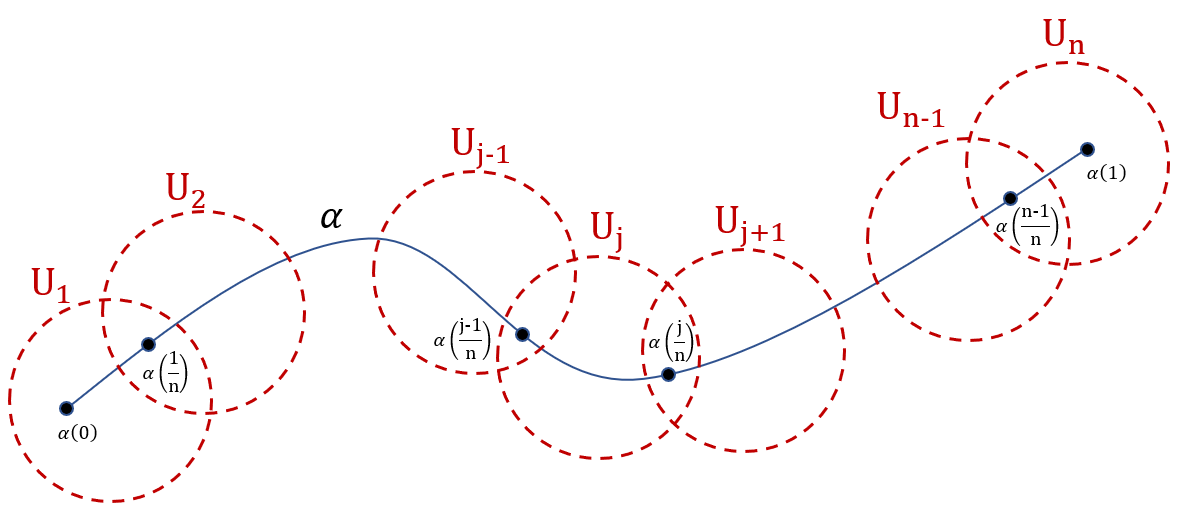
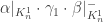
For each , let be an open neighborhood of such that every loop in is null-homotopic in (here, we are using the semilocally simply connected property). Using the Lebesgue Number Lemma, we may find an integer such that if (as in Part 1), then for each , we have for some . To simplify notation, we’ll write for .
Now we have . However, it may not be the case that the intersection is path connected. We can address this issue in the following way. Since is locally path connected, for each , find a path-connected neighborhood latex of such that .
Now we are ready to define the neighborhood
Recall that the notation denotes the set consisting of all loops that map the compact set into the open set . So we can think of above as the set of all loops that follow an ordered list of instructions. If , then must first proceed through and end somehwere in . It must then proceed through and end in , etc.
The neighborhood of .
Our remaining job is to show that is open and this will be done if we can show that , that is every loop in is homotopic to .
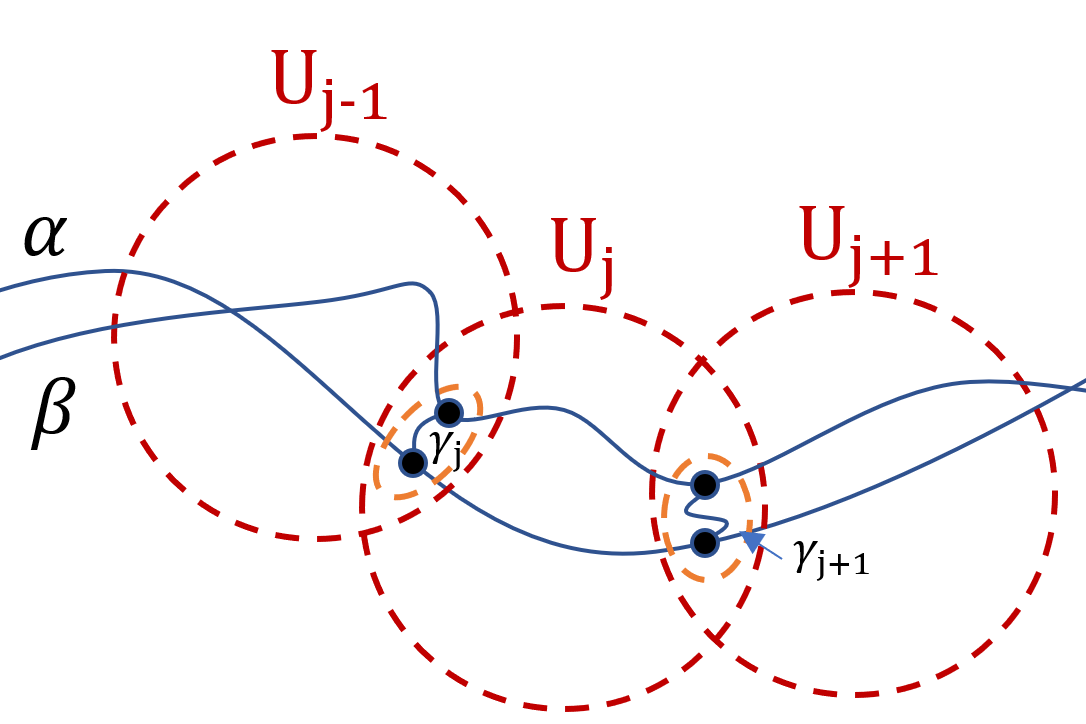
Let . We’ll construct a homotopy . For , both and lies in and so we may find a path from to .
The path and the connecting paths .
Notice that
is a loop in ,
is a loop in when ,
is a loop in .
A close-up view of the general case where we have create a loop in with corresponding portions of and . Since this loop lies in , it is null-homotopic in .
By our choice of the sets , all of these loops are null-homotopic in . In particular, this means that
,
when ,
.
Composing these homotopies “horizontally” gives that is homotopic to
cancelling the inverse pairs gives a homotopy with . Thus . We conclude that .
Lemmas 1 and 2 tell us that for locally path-connected spaces, being semilocally simply connected is equivalent to being a discrete group.
Theorem: Suppose is locally path connected. Then is discrete if and only if is semilocally simply connected.
This tells us that, for locally path-connected spaces, non-discreteness of as a topological invariant, really is detecting the existence of local 1-dimensional wildness in a space. When our space in question is not locally path connected, things get a bit trickier.
Example: The following “hoop earring” space is semilocally simply connected but is not locally path-connected. This space includes the sequence of circles that all meet at a point and includes the limit circle too. If is the loop going once around the n-th circle (parameterized in a standard way) and goes once around the limit circle, then in the compact-open topology and so in even though none of these homotopy classes are the same. Since contains a non-trivial convergent sequence, it can’t be discrete. In fact, this group is isomorphic to something called a free topological group (but that’s much harder to show)!
The space : a wedge of converging circles has non-discrete fundamental group.













 ,
,  IS continuous and it descends to the multiplication operation
  ,
, ![\mu([\alpha],[\beta])=[\alpha\cdot\beta]](https://s0.wp.com/latex.php?latex=%5Cmu%28%5B%5Calpha%5D%2C%5B%5Cbeta%5D%29%3D%5B%5Calpha%5Ccdot%5Cbeta%5D&bg=ffffff&fg=333333&s=0&c=20201002) . In this post, I’ll detail out an important example showing why
. In this post, I’ll detail out an important example showing why  isn’t always continuous.
  is the natural quotient map and the product
  is a quotient map, then because
  , the universal property of quotient maps ensures that
  where
where  is the circle of radius
  centered at
  . We take the basepoint
  to be the origin. For brevity, let’s let
  denote the loop space and
  be the earring group with the natural quotient topology.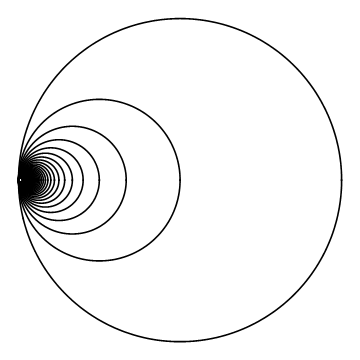
![\ell_n:[0,1]\to C_n](https://s0.wp.com/latex.php?latex=%5Cell_n%3A%5B0%2C1%5D%5Cto+C_n&bg=ffffff&fg=333333&s=0&c=20201002) be the standard paramterization of
be the standard paramterization of  going once around counterclockwise and
 ![x_n=[\ell_n]\in G](https://s0.wp.com/latex.php?latex=x_n%3D%5B%5Cell_n%5D%5Cin+G&bg=ffffff&fg=333333&s=0&c=20201002) . The group
. The group  in
in  and
and  are elements of
  or
or ![[a,b]](https://s0.wp.com/latex.php?latex=%5Ba%2Cb%5D&bg=ffffff&fg=333333&s=0&c=20201002) to denote the commutator
to denote the commutator  and
and  will be the
  -fold product
  of a word
  with itself. We’ll write
  for both the constant loop at
 ![w_{m,n}=[x_m,x_n]^{m}](https://s0.wp.com/latex.php?latex=w_%7Bm%2Cn%7D%3D%5Bx_m%2Cx_n%5D%5E%7Bm%7D&bg=ffffff&fg=333333&s=0&c=20201002) for
for  .
. and the word length otherwise is
  .
. . Then
 ![w_{m,n_k}=[x_{m_k},x_{n}]^{m_k}](https://s0.wp.com/latex.php?latex=w_%7Bm%2Cn_k%7D%3D%5Bx_%7Bm_k%7D%2Cx_%7Bn%7D%5D%5E%7Bm_k%7D&bg=ffffff&fg=333333&s=0&c=20201002) is a sequence of reduced words of unbounded length. In fact, the number of appearrances of the letter
is a sequence of reduced words of unbounded length. In fact, the number of appearrances of the letter  . Hence, if we considering representing loops
  , then, for each
  , the loop
  may not be reduced (in the sense of not having any null-homotopic subloops) but because
  is a reduced word, the loop
  -many distinct times. Since the topology of
  with to converge to any loop in
  . Then
 ![[\ell_m,\ell_n]^{m}](https://s0.wp.com/latex.php?latex=%5B%5Cell_m%2C%5Cell_n%5D%5E%7Bm%7D&bg=ffffff&fg=333333&s=0&c=20201002) has fixed “word length” as
has fixed “word length” as  and converges to the null-homotopic loop
 ![[\ell_m,e]^m](https://s0.wp.com/latex.php?latex=%5B%5Cell_m%2Ce%5D%5Em&bg=ffffff&fg=333333&s=0&c=20201002) . Therefore,
. Therefore,  when
when  . In fact, we show something stronger next.
 be an open neighborhood of
  is an open neighborhood of the constant loop at
  of
of  such that all loops
 ![([0,1],\{0,1\})\to (O,x_0)](https://s0.wp.com/latex.php?latex=%28%5B0%2C1%5D%2C%5C%7B0%2C1%5C%7D%29%5Cto+%28O%2Cx_0%29&bg=ffffff&fg=333333&s=0&c=20201002) lie in
lie in  such that
  . Let
. Let  with
with  . Since
  and
and  have image in
 ![[\ell_{m},\ell_{n}]^{m}](https://s0.wp.com/latex.php?latex=%5B%5Cell_%7Bm%7D%2C%5Cell_%7Bn%7D%5D%5E%7Bm%7D&bg=ffffff&fg=333333&s=0&c=20201002) . Thus
. Thus ![[\ell_{m},\ell_{n}]^{m}\in q^{-1}(U)](https://s0.wp.com/latex.php?latex=%5B%5Cell_%7Bm%7D%2C%5Cell_%7Bn%7D%5D%5E%7Bm%7D%5Cin+q%5E%7B-1%7D%28U%29&bg=ffffff&fg=333333&s=0&c=20201002) which gives
which gives ![w_{m,n}=q([\ell_{m},\ell_{n}]^{m})\in U](https://s0.wp.com/latex.php?latex=w_%7Bm%2Cn%7D%3Dq%28%5B%5Cell_%7Bm%7D%2C%5Cell_%7Bn%7D%5D%5E%7Bm%7D%29%5Cin+U&bg=ffffff&fg=333333&s=0&c=20201002) for all
for all ![v_{m,n}=[x_1,x_m]^{n}](https://s0.wp.com/latex.php?latex=v_%7Bm%2Cn%7D%3D%5Bx_1%2Cx_m%5D%5E%7Bn%7D&bg=ffffff&fg=333333&s=0&c=20201002) for
for  is trivial and the word length otherwise is
  .
. and suppose
  . Then
 ![v_{m,n_k}=[x_1,x_{m}]^{n_k}](https://s0.wp.com/latex.php?latex=v_%7Bm%2Cn_k%7D%3D%5Bx_1%2Cx_%7Bm%7D%5D%5E%7Bn_k%7D&bg=ffffff&fg=333333&s=0&c=20201002) is a sequence of reduced words of unbounded length such that the number of appearrances of
is a sequence of reduced words of unbounded length such that the number of appearrances of  is unbounded as
  , then
  -many copies of the loop
  as a subloop. Thus there is no way for the sequence
 ![[\ell_1,\ell_{m}]^{n}](https://s0.wp.com/latex.php?latex=%5B%5Cell_1%2C%5Cell_%7Bm%7D%5D%5E%7Bn%7D&bg=ffffff&fg=333333&s=0&c=20201002) has fixed length, it converges uniformly to
has fixed length, it converges uniformly to ![[\ell_1,e]^{n}](https://s0.wp.com/latex.php?latex=%5B%5Cell_1%2Ce%5D%5E%7Bn%7D&bg=ffffff&fg=333333&s=0&c=20201002) , which is null-homotopic. The continuity of
, which is null-homotopic. The continuity of  , then ensures that
  in
in  is a limit point of
  .
. and
and  to define the set we really want to focus on. In particular, let
 consists of the doubly indexed sequences:
![w_{m,n}v_{m,n}=[x_m,x_n]^{m}[x_1,x_m]^{n}](https://s0.wp.com/latex.php?latex=w_%7Bm%2Cn%7Dv_%7Bm%2Cn%7D%3D%5Bx_m%2Cx_n%5D%5E%7Bm%7D%5Bx_1%2Cx_m%5D%5E%7Bn%7D&bg=ffffff&fg=333333&s=0&c=20201002) .
. and
and  . Let’s show that
  is not closed in
  . First the easy direction.
 is not closed in
  , the pair
  cannot be an element of
  . The fourth observation for each doubly-indexed sequence above tells us that
  and
and  in
in  in
in 
 in
in  for all
  , we have
  .
. is closed if and only if
  and a convergent sequence
  in
in  , we could lift it to a convergent sequence in
  in
in  and
and  .
. that is constant at
  , then the conclusion is easy to acheive. Suppose
  . Then
  is not closed in
  in
in  for all
  and
and  . We have
  for some
  . If the sequence of integers
  is bounded by
  , then
  has image in the finite set
  . But since
  is closed and so we must have
  ; a contradiction. Thus
  and since
  . Since
  be the finite wedge of circles so that
  is the free group
  on the letters
  . From
  that collapse
  to
to  . We also have bonding retractions
  , which collapse
  to
to  on the discrete free groups. The inverse limit
  is topologized as a subspace of the product
  . Since this product is Hausdorff, so is
  , we have an induced continuous homomorphism
  given by
  . We proved in
  is injective (warning!
  is closed in
  be a convergent sequence in
  for all
 ![g_k=w_{m_k,n_k}v_{m_k,n_k}=[x_{m_k},x_{n_k}]^{m_k}[x_1,x_{m_k}]^{n_k}](https://s0.wp.com/latex.php?latex=g_k%3Dw_%7Bm_k%2Cn_k%7Dv_%7Bm_k%2Cn_k%7D%3D%5Bx_%7Bm_k%7D%2Cx_%7Bn_k%7D%5D%5E%7Bm_k%7D%5Bx_1%2Cx_%7Bm_k%7D%5D%5E%7Bn_k%7D&bg=ffffff&fg=333333&s=0&c=20201002)
 with
with  . We must check that
  . Note that by Lemma 4, there exists integers
  and a convergent sequence of loops
  in
in ![[\alpha_j]=g_{k_j}](https://s0.wp.com/latex.php?latex=%5B%5Calpha_j%5D%3Dg_%7Bk_j%7D&bg=ffffff&fg=333333&s=0&c=20201002) and
and ![[\alpha]=g](https://s0.wp.com/latex.php?latex=%5B%5Calpha%5D%3Dg&bg=ffffff&fg=333333&s=0&c=20201002) .
. and
and  is a finite subset of
  .
. is unbounded and the (possibly unreduced) loop
  must go around the circle
  in one-direction or the other at least
  -many times (this is contributed by the subword
  of
of  ). But this makes it impossible for the sequence
  to converge uniformly to any loop; a contradiction. Therefore, this case is impossible.
 is unbounded and
  for infinitely many
  . By replacing
  with the subsequence of
  . Recall that (the possibly unreduced loop)
  represents
 ![[x_{m_{k_j}},x_{N}]^{m_{k_j}}[x_1,x_{m_{k_j}}]^{N}](https://s0.wp.com/latex.php?latex=%5Bx_%7Bm_%7Bk_j%7D%7D%2Cx_%7BN%7D%5D%5E%7Bm_%7Bk_j%7D%7D%5Bx_1%2Cx_%7Bm_%7Bk_j%7D%7D%5D%5E%7BN%7D&bg=ffffff&fg=333333&s=0&c=20201002) and so
and so  in one-direction or the other at least
  -many times (this is contributed by the subword
  of
of  is the group operation. Thus
  tells us that we can topologically identify
  with the planar subset
  . Here I’m fudging the fact that we needed to get rid of the diagonal and the first row and column in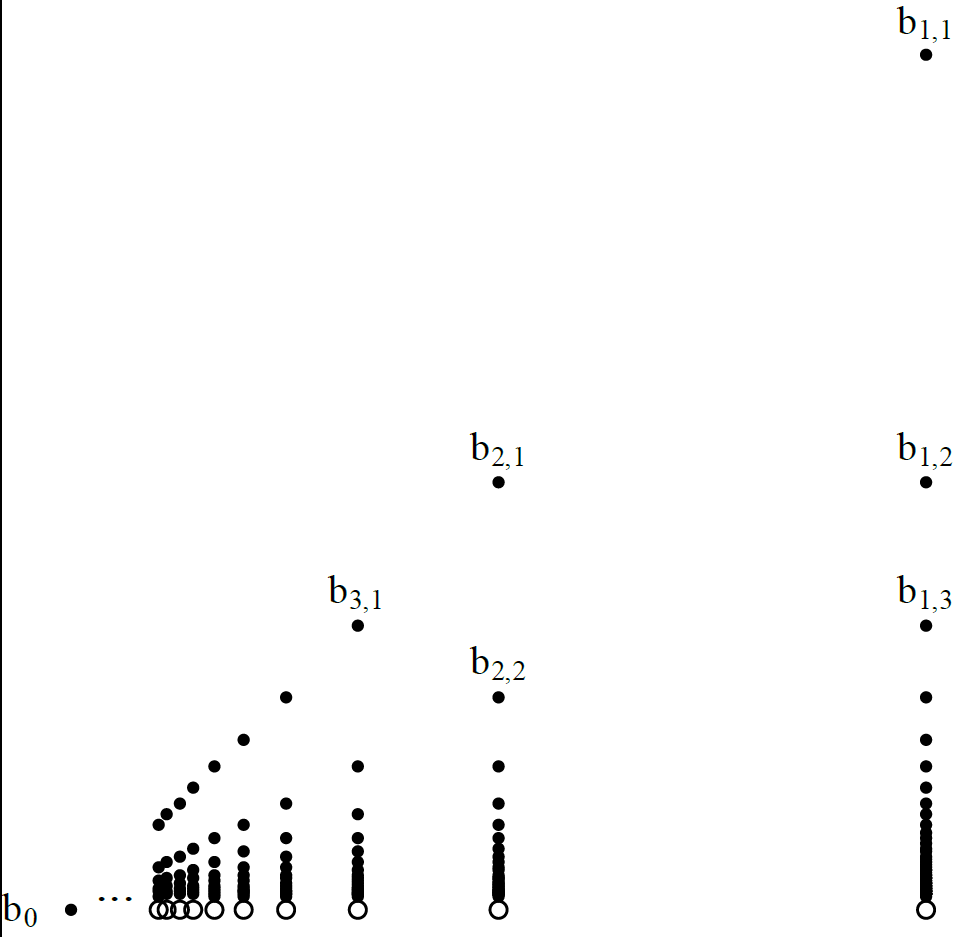
 consisting of the origin and points
  .
. work a little differently. If we lay out these points on the integer grid in the same way (so
  is at
is at  ), then none of the vertical sequences converge. In fact, any sequence which meets infinitely many rows cannot converge. However, along the fixed row at height
  converges to the identity
 ![e=[x_1,e]^{n}](https://s0.wp.com/latex.php?latex=e%3D%5Bx_1%2Ce%5D%5E%7Bn%7D&bg=ffffff&fg=333333&s=0&c=20201002) . This essentially means that
. This essentially means that  is a copy of the Frechet Uryshon Fan, which I’ll denote by
  . The Frechet Urysohn Fan can be constructed by infinitely many disjoint convergent sequences
  with their limits points
  identified. We then give
  the weak topology with respect to the subspaces
  .
.
 -action [3] all kind of look like this one. So, I suspect there is a deeper thread here to unravel.
  is detecting some non-trivial local structures in
  is the loop space with the compact-open topology and
  ,
, ![q(\alpha)=[\alpha]](https://s0.wp.com/latex.php?latex=q%28%5Calpha%29%3D%5B%5Calpha%5D&bg=ffffff&fg=333333&s=0&c=20201002) identifying homotopy classes of loops. We’ll need to use the description of a basis for the compact-open topology from
identifying homotopy classes of loops. We’ll need to use the description of a basis for the compact-open topology from  if there exists an open neighborhood
  induced by the inclusion map
  is trivial, that is, if every loop in
 ![\alpha:[0,1]\to X](https://s0.wp.com/latex.php?latex=%5Calpha%3A%5B0%2C1%5D%5Cto+X&bg=ffffff&fg=333333&s=0&c=20201002) from
from  be the set of open sets in
  , there exists a loop
 ![\beta_{U}:[0,1]\to U](https://s0.wp.com/latex.php?latex=%5Cbeta_%7BU%7D%3A%5B0%2C1%5D%5Cto+U&bg=ffffff&fg=333333&s=0&c=20201002) based at
based at  is not null-homotopic in
 ![[\beta_{U}]\neq 1](https://s0.wp.com/latex.php?latex=%5B%5Cbeta_%7BU%7D%5D%5Cneq+1&bg=ffffff&fg=333333&s=0&c=20201002) in
in  . Thus
 ![[\alpha\cdot\beta_{U}\cdot\alpha^{-}]\neq 1](https://s0.wp.com/latex.php?latex=%5B%5Calpha%5Ccdot%5Cbeta_%7BU%7D%5Ccdot%5Calpha%5E%7B-%7D%5D%5Cneq+1&bg=ffffff&fg=333333&s=0&c=20201002) in
in  is a net in
  in the compact-open topology where
  denotes the constant loop at
 ![\{[\alpha\cdot\beta_{U}\cdot\alpha^{-}]\}_{U\in\mathscr{N}}](https://s0.wp.com/latex.php?latex=%5C%7B%5B%5Calpha%5Ccdot%5Cbeta_%7BU%7D%5Ccdot%5Calpha%5E%7B-%7D%5D%5C%7D_%7BU%5Cin%5Cmathscr%7BN%7D%7D&bg=ffffff&fg=333333&s=0&c=20201002) converges to the identity element
converges to the identity element ![1=[\alpha\cdot c_x\cdot \alpha^{-}]](https://s0.wp.com/latex.php?latex=1%3D%5B%5Calpha%5Ccdot+c_x%5Ccdot+%5Calpha%5E%7B-%7D%5D&bg=ffffff&fg=333333&s=0&c=20201002) in
in  can be open. Thus
 ![\{[\alpha]\}](https://s0.wp.com/latex.php?latex=%5C%7B%5B%5Calpha%5D%5C%7D&bg=ffffff&fg=333333&s=0&c=20201002) is open. Since
is open. Since  is a quotient map,
 ![q^{-1}(\{[\alpha]\})=[\alpha]](https://s0.wp.com/latex.php?latex=q%5E%7B-1%7D%28%5C%7B%5B%5Calpha%5D%5C%7D%29%3D%5B%5Calpha%5D&bg=ffffff&fg=333333&s=0&c=20201002) is open in
is open in ![[\alpha]](https://s0.wp.com/latex.php?latex=%5B%5Calpha%5D&bg=ffffff&fg=333333&s=0&c=20201002) is the homotopy class of
is the homotopy class of  , that is, the set of all loops path-homotopic to
 ![t\in [0,1]](https://s0.wp.com/latex.php?latex=t%5Cin+%5B0%2C1%5D&bg=ffffff&fg=333333&s=0&c=20201002) , let
, let  be an open neighborhood of
  such that every loop in
  such that if
 ![K_{n}^{j}=\left[\frac{j-1}{n},\frac{j}{n}\right]](https://s0.wp.com/latex.php?latex=K_%7Bn%7D%5E%7Bj%7D%3D%5Cleft%5B%5Cfrac%7Bj-1%7D%7Bn%7D%2C%5Cfrac%7Bj%7D%7Bn%7D%5Cright%5D&bg=ffffff&fg=333333&s=0&c=20201002) (as in Part 1), then for each
(as in Part 1), then for each  , we have
  for some
  . To simplify notation, we’ll write
  for
for  .
.
 . However, it may not be the case that the intersection
  is path connected. We can address this issue in the following way. Since
  , find a path-connected neighborhood latex
  of
of  such that
  .
.
 denotes the set consisting of all loops that map the compact set
  above as the set of all loops that follow an ordered list of instructions. If
  , then
  must first proceed through
  and end somehwere in
  . It must then proceed through
  and end in
  , etc.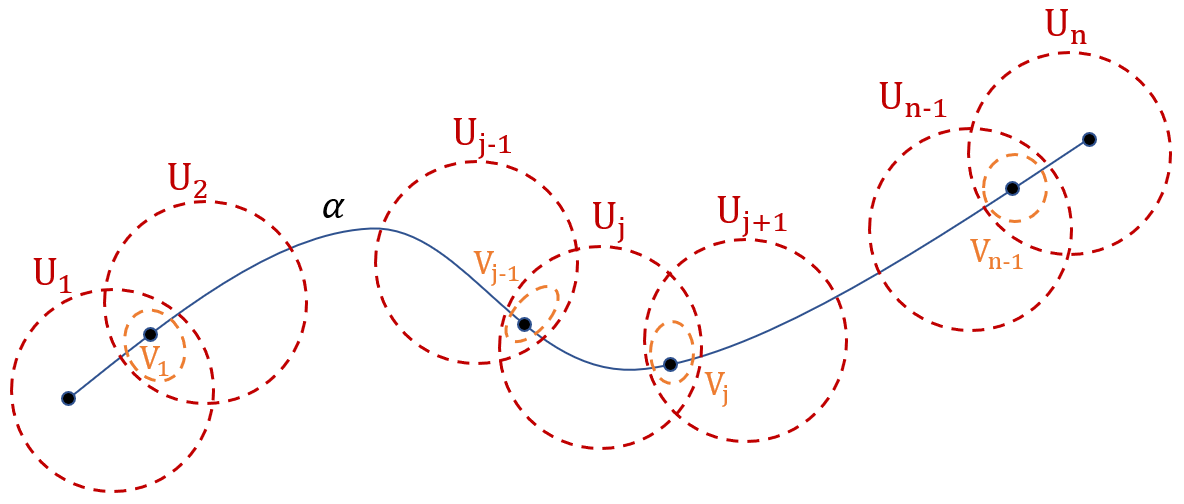
![\mathscr{U}\subseteq [\alpha]](https://s0.wp.com/latex.php?latex=%5Cmathscr%7BU%7D%5Csubseteq+%5B%5Calpha%5D&bg=ffffff&fg=333333&s=0&c=20201002) , that is every loop in
, that is every loop in  . For
. For  , both
  and
and  lies in
 ![\gamma_j:[0,1]\to V_j](https://s0.wp.com/latex.php?latex=%5Cgamma_j%3A%5B0%2C1%5D%5Cto+V_j&bg=ffffff&fg=333333&s=0&c=20201002) from
from 
 .
. is a loop in
  is a loop in
  ,
, is a loop in
  .
.
 ,
, when
when  .
. is homotopic to
 gives a homotopy with
  . Thus
  and includes the limit circle too. If
 ![\ell_n:[0,1]\to Y](https://s0.wp.com/latex.php?latex=%5Cell_n%3A%5B0%2C1%5D%5Cto+Y&bg=ffffff&fg=333333&s=0&c=20201002) is the loop going once around the n-th circle (parameterized in a standard way) and
is the loop going once around the n-th circle (parameterized in a standard way) and ![\ell_{\infty}:[0,1]\to Y](https://s0.wp.com/latex.php?latex=%5Cell_%7B%5Cinfty%7D%3A%5B0%2C1%5D%5Cto+Y&bg=ffffff&fg=333333&s=0&c=20201002) goes once around the limit circle, then
goes once around the limit circle, then  in the compact-open topology and so
 ![\{[\ell_n]\}\to [\ell_{\infty}]](https://s0.wp.com/latex.php?latex=%5C%7B%5B%5Cell_n%5D%5C%7D%5Cto+%5B%5Cell_%7B%5Cinfty%7D%5D&bg=ffffff&fg=333333&s=0&c=20201002) in
in  even though none of these homotopy classes are the same. Since
 Wild Topology