Say you’ve got some path-connected space  and you want to know about it’s fundamental group
  . But isn’t locally path-connected so pretty much any standard tools in algebraic topology aren’t going to help you out. What’s an algebraic topologist to do? This post is about a simple but remarkably useful construction that will give you a locally path-connected spaces
  which has the same underlying set as but which does not change the fundamental group (or any homotopy or homology groups).
The construction is based on the following basic fact from general topology: If is locally path-connected and  is an open set of , then the path-components of are open in .
Definition 1: Suppose is a topological space. Let be the space with the same underlying set as but whose topology is generated by the path-components of the open sets of .
This means a basic open sets in is the path-component  of an open set in . Let
  be the collection of such basic open sets. The rest of this post will be devoted to exploring the basic properties of this construction.
Some preliminary facts
Proposition 2: is actually a basis for a topology on the underlying set of .
Proof. Certainly every point of  is contained is some path-component of . Suppose
  and
and  are open in and
  . Let
. Let  be the path-component of in
  for
for  and be the path-component of in the intersection
  . It suffices to show that
  . If
. If  , then there is a path
  from
from  to in
to in  Since is the path-component of in , the path must have image in both
  and
and  . Thus
  .
. 
Proposition 3: The topology of is finer than the topology of . Equivalently, the identity function  is continuous.
Proof. If is open in , then is the union of it’s path-components and is therefore a union of basic open sets in . Therefore the topology of is finer than the topology of .
Here is the most important property of .
Theorem 4: Suppose  is locally path-connected and
  is a continuous function. Then the function
  is also continuous.
Proof. Suppose is the path-component of an open subset of (so that is a basic open set in ). Suppose  such that
  . Since is continuous and is an open neighborhood of
  in , there is an open neighborhood
  of
of  in such that
  . Now since is locally path-connected, we may find a path-connected open set
  in such that
  . It suffices to check that
  . If
. If  , then there is a path
 ![\gamma:[0,1]\to W](https://s0.wp.com/latex.php?latex=%5Cgamma%3A%5B0%2C1%5D%5Cto+W&bg=ffffff&fg=333333&s=0&c=20201002) from to
from to  . Now
. Now ![f\circ\gamma:[0,1]\to f(W)\subseteq f(V)\subseteq U](https://s0.wp.com/latex.php?latex=f%5Ccirc%5Cgamma%3A%5B0%2C1%5D%5Cto+f%28W%29%5Csubseteq+f%28V%29%5Csubseteq+U&bg=ffffff&fg=333333&s=0&c=20201002) is a path from to
is a path from to  . Since is the path-component of in , we must have
  . This proves .
Another way to think about this is in terms of hom-sets of continuous functions. Here  denote the category of topological spaces and continuous functions. Thus
  is the set of all continuous functions
  .
.
Corollary 5: If is locally path-connected, then the continuous identity induces a bijection  given by composing a map
  with .
Proof. Injectivity of  follows from the injectivity of the identity function and surjectivity of follows from Theorem 4.
Of course, an important case of Theorem 4 is when we take ![Y=[0,1]](https://s0.wp.com/latex.php?latex=Y%3D%5B0%2C1%5D&bg=ffffff&fg=333333&s=0&c=20201002) to be the unit interval. In this case, the above corollary can be interpreted as the fact that and have the same paths and homotopies of paths. For one, if is path-connected, then so is .
to be the unit interval. In this case, the above corollary can be interpreted as the fact that and have the same paths and homotopies of paths. For one, if is path-connected, then so is .
The original intent was to construct a locally path-connected version of a space in an “efficient” way. Let’s continue to check that we’ve actually done this.
Theorem 6: is locally path-connected. Moreover,  if and only if is locally path-connected.
Proof. Suppose is a basic open neighborhood of a point  . By construction of , is the path-component of an open neighborhood in . It is important to notice here that the subspace topologies with respect to the topologies of and may be different so it is not completely obvious that is path-connected as a subspace of . The above theorem will help us out though. Let
  . Then there is a path
 ![\gamma:[0,1]\to X](https://s0.wp.com/latex.php?latex=%5Cgamma%3A%5B0%2C1%5D%5Cto+X&bg=ffffff&fg=333333&s=0&c=20201002) with image in and
with image in and  and
and  . Since
 ![\gamma:[0,1]\to lpc(X)](https://s0.wp.com/latex.php?latex=%5Cgamma%3A%5B0%2C1%5D%5Cto+lpc%28X%29&bg=ffffff&fg=333333&s=0&c=20201002) is also continuous and has image in the subset , we can conclude that and can be connect by a path in the subspace of . Thus is indeed path-connected as a subspace of confirming that is indeed locally path-connected.
is also continuous and has image in the subset , we can conclude that and can be connect by a path in the subspace of . Thus is indeed path-connected as a subspace of confirming that is indeed locally path-connected.
For the second statement, it is now clear that if , then is locally path-connected. Conversely, if is locally path-connected, then according to Theorem 4, the continuity of the identity function  implies the continuity of the identity function
  . We already knew the identity
  was continuous so the topologies of and must be identical.
A categorical interpretation
The construction of is a special type of functor called a coreflection function – the idea being that the category  of locally path-connected spaces is a subcategory of such that for every object of there is a “most efficient” way to construct a corresponding object of .
Definition 7: Suppose  is a category and
  is a subcategory. We say is a coreflective subcategory of if the inclusion functor
  has a right adjoint
  called a coreflection functor.
If we break this definition down, the fact that  is right adjoint to the inclusion means that for every object of , there is an object
  of and a morphism
  in which induces a bijection

for every object  of . This is precisely our situation:
  and
and  is the continuous identity.
Theorem 8:  is a functor right adjoint to the inclusion functor
  .
.
Proof. We’ve already confirmed that we have all the right ingredients. Let’s just put them together. First, we check that  is a functor. We have left to see what it does to morphisms. If
  is a continuous function of any spaces, then we may compose it with the continuous identity to get a continuous function
  . Since is locally path-connected, Theorem 4 guarantees that
  is continuous (notice this is actually the same function, it’s just the spaces have different topologies). Thus is the identity on both underlying sets and functions. From here it is more or less obvious that preserves identities and composition.
Theorem 4 then shows that is in fact right adjoint to the inclusion since if  and
and  are locally path-connected, then
  (i.e. is a full subcategory of ). The natural bijection

also is described in Corollary 5.
This is why it is appropriate to call the locally path-connected coreflection of or the -coreflection of .
Some Examples
For a real number  , let
, let  be the circle of radius
  centered at
  . Additionally, if
  , let
, let  .
.
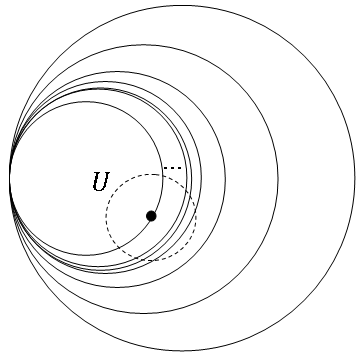
Example: Let  . Then
  is a non-locally path-connected, compact planar set that looks something like this:
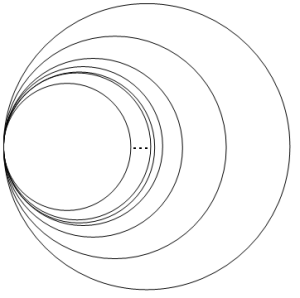
This is something like a generalized wedge of circles; in fact is homeormophic to the reduced suspension of  . What is ? Well the topology should only change near points where is not locally path-connected. Here that is the set
  . A basic neighborhood of a point in this set is a union of intervals, which are precisely the the path-components of .
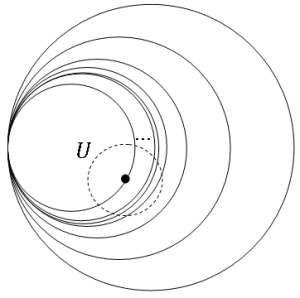
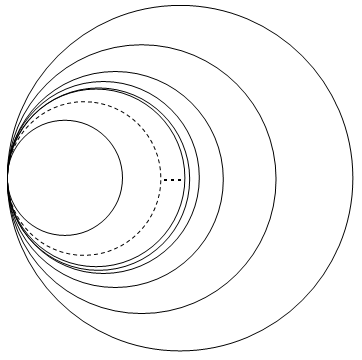
In particular, the arc  is open in illustrating the fact that the circles
  no longer converge to . In particular, is homeomorphic to the following planar set where the “limit” circle is no longer a topological limit.
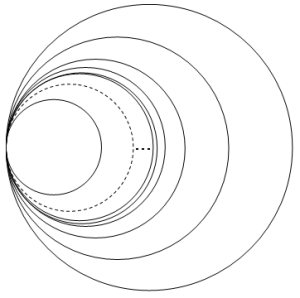
Since the circles in are “discrete,” the resulting space is a wedge of circles but technically does not have the CW-topology (which would not be first countable). Instead, it has a metrizable topology. To be fair, I kind of doubt that  can always be embedded in
  whenever the space can. Regardless, we know spaces and have the same homotopy groups but are not homotopy equivalent (an easy way to prove this is using a topologized version of the fundamental group). In fact, all higher homotopy groups are trivial and both fundamental groups are free on a countably infinite set of generators.
Similarly, if  , then
  is not locally path-connected – it looks like a wedge of circles in which the circles are parameterized by the rationals. But the -coreflection is also a countable wedge of circles (with a metrizable topology) – in fact
  .
.
If we take  , then we get the usual earring space. This is already locally path-connected so
  .
.
Other examples:
- For any totally path-disconnected space (i.e. a space in which every path-component is a point) the -coreflection must be discrete. So if
 is the rationals, then
  is a countable discrete space. More generally,
 ![[0,1]](https://s0.wp.com/latex.php?latex=%5B0%2C1%5D&bg=ffffff&fg=333333&s=0&c=20201002) cannot be the countable disjoint union of closed sets so, in general, if is a countable
cannot be the countable disjoint union of closed sets so, in general, if is a countable  space, then must be discrete. Similarly, if is the cantor set, then
  is an uncountable discrete space.
- One could replace circles in the above example with a similar construction using n-spheres in
 and obtain examples with non-trivial higher homotopy and homology groups.
More algebraic topology
For based spaces  and
and  , let
, let ![[(Y,y),(X,x)]](https://s0.wp.com/latex.php?latex=%5B%28Y%2Cy%29%2C%28X%2Cx%29%5D&bg=ffffff&fg=333333&s=0&c=20201002) denote the set of based homotopy classes of based maps
denote the set of based homotopy classes of based maps  .
.
Theorem 9: If is locally path-connected, the identity function induces a bijection of homotopy classes ![[(Y,y),(lpc(X),x)]\to[(Y,y),(X,x)]](https://s0.wp.com/latex.php?latex=%5B%28Y%2Cy%29%2C%28lpc%28X%29%2Cx%29%5D%5Cto%5B%28Y%2Cy%29%2C%28X%2Cx%29%5D&bg=ffffff&fg=333333&s=0&c=20201002) .
.
Proof. Surjectivity follows directly from Theorem 4. Suppose  are maps such that
  are homotopic. Then
  is locally path-connected and the homotopy
 ![H:Y\times [0,1]\to X](https://s0.wp.com/latex.php?latex=H%3AY%5Ctimes+%5B0%2C1%5D%5Cto+X&bg=ffffff&fg=333333&s=0&c=20201002) is also continuous with respect to the topology of . Thus we obtain a based homotopy
is also continuous with respect to the topology of . Thus we obtain a based homotopy ![H:Y\times [0,1]\to lpc(X)](https://s0.wp.com/latex.php?latex=H%3AY%5Ctimes+%5B0%2C1%5D%5Cto+lpc%28X%29&bg=ffffff&fg=333333&s=0&c=20201002) between . This shows the function on homotopy classes is injective. .
between . This shows the function on homotopy classes is injective. .
In the case that  is the two-point space, we see that induces a bijection
  of path-components. When
  is the n-sphere, we get the following corollary.
Corollary 10: The identity function induces an isomorphism  of homotopy groups for all
  and
and  .
.
Replacing maps on spheres with maps on the standard n-simplex  , we see there is a canonical bijection between singular n-chains in and . This means similar arguments give the same result for homology groups.
Corollary 11: The identity function induces isomorphisms  and
and  of singular homology and cohomology groups for all
  .
.
One of the limitations of algebraic topology is that most techniques do not apply to non-locally path-connected spaces. For instance, covering spaces of locally path-connected spaces are uniquely determined (up to isomorphism) by the corresponding  action on the fiber, but this convenience only translates to very special types of non-locally path-connected spaces. As long as the goal is to understand the homotopy and (co)homology groups of the space, and not to characterize the homotopy type, the -coreflection allows one to assume the space in question is locally path-connected.
Definition 12: A space is semi-locally simply connected if for every point , there is an open neighborhood of such that the inclusion  induces the trivial homomorphism
  on fundamental groups.
It’s an important fact from covering space theory that every path-connected, locally path-connected and semi-locally simply connected admits a universal (simply connected) covering  .
.
Proposition 13: is semi-locally simply connected if and only if is semi-locally simply connected.
Proof. First suppose is semi-locally simply connected. Suppose and is an open neighborhood of such that the inclusion induces the trivial homomorphism . Let be the path-component of in . Then is an open neighborhood of in . The inclusion  induces a homomorphism
  which factors as
  where the later homomorphism is trivial. Thus
  is trivial.
Conversely, suppose is semi-locally simply connected and . Find an open neighborhood of in such that  . We can assume is a basic neighborhood, so that is the path-component of an open set of . If
 ![\alpha:[0,1]\to U](https://s0.wp.com/latex.php?latex=%5Calpha%3A%5B0%2C1%5D%5Cto+U&bg=ffffff&fg=333333&s=0&c=20201002) is a loop based , then it must have image in . Since
is a loop based , then it must have image in . Since  is null-homotopic in , it must be null-homotopic when viewed as a loop in . Thus is trivial.
Corollary 14: If is path-connected and semi-locally simply connected, then admits a universal covering  .
.
The composition  is essentially a universal covering of the space except it doesn’t exactly satisfy the local triviality part of the definition of a covering map. However, it does have pretty much all of the same lifting properties as a covering map: if
  is path-connected,
  locally path-connected, and
  is a map such that
  , then there is a unique continuous lift
  satisfying
  .
.
Take the example of the generalized wedge of circles pictured above. This space does not have a universal covering space but it’s -coreflection does. We can conclude that for many non-locally path-connected spaces, there is still a covering theoretic approach to characterizing the structure of the fundamental group – just apply the locally path-connected coreflection first.
For more, see:
The locally path-connected coreflection (Part II)
The locally path-connected coreflection (Part III)


![\alpha:[0,1]\to V](https://s0.wp.com/latex.php?latex=%5Calpha%3A%5B0%2C1%5D%5Cto+V&bg=ffffff&fg=333333&s=0&c=20201002)

![q\circ\alpha:[0,1]\to q(V)\subseteq U](https://s0.wp.com/latex.php?latex=q%5Ccirc%5Calpha%3A%5B0%2C1%5D%5Cto+q%28V%29%5Csubseteq+U&bg=ffffff&fg=333333&s=0&c=20201002)





is open in
.
, then there is a
such that
for all
.
![(X_j,x_j)=([0,1],0)](https://s0.wp.com/latex.php?latex=%28X_j%2Cx_j%29%3D%28%5B0%2C1%5D%2C0%29&bg=ffffff&fg=333333&s=0&c=20201002)
![ah(J)=\widetilde{\bigvee}_{j\in J}[0,1]_j](https://s0.wp.com/latex.php?latex=ah%28J%29%3D%5Cwidetilde%7B%5Cbigvee%7D_%7Bj%5Cin+J%7D%5B0%2C1%5D_j&bg=ffffff&fg=333333&s=0&c=20201002)


![\alpha_V:[0,1]\to V](https://s0.wp.com/latex.php?latex=%5Calpha_V%3A%5B0%2C1%5D%5Cto+V&bg=ffffff&fg=333333&s=0&c=20201002)

![\alpha_{V}:[0,1]_{V}\to V](https://s0.wp.com/latex.php?latex=%5Calpha_%7BV%7D%3A%5B0%2C1%5D_%7BV%7D%5Cto+V&bg=ffffff&fg=333333&s=0&c=20201002)


![[0,1]_V](https://s0.wp.com/latex.php?latex=%5B0%2C1%5D_V&bg=ffffff&fg=333333&s=0&c=20201002)


 on
on ![\alpha:[0,1]\to X](https://s0.wp.com/latex.php?latex=%5Calpha%3A%5B0%2C1%5D%5Cto+X&bg=ffffff&fg=333333&s=0&c=20201002) and
and ![t\in[0,1]](https://s0.wp.com/latex.php?latex=t%5Cin%5B0%2C1%5D&bg=ffffff&fg=333333&s=0&c=20201002) , let
, let 
 for any
  by the triangle inequality.
![\ell(\alpha)=\sup\{\ell_t(\alpha)|t\in[0,1]\}](https://s0.wp.com/latex.php?latex=%5Cell%28%5Calpha%29%3D%5Csup%5C%7B%5Cell_t%28%5Calpha%29%7Ct%5Cin%5B0%2C1%5D%5C%7D&bg=ffffff&fg=333333&s=0&c=20201002) .
. , we define our metric as
 for any path
  to
to  , we get that
  showing that the identity
  are paths in
  , then
  denotes the reverse of
  denotes the usual concatenation of paths
 .
. and given
 ![t\in[0,1/2]](https://s0.wp.com/latex.php?latex=t%5Cin%5B0%2C1%2F2%5D&bg=ffffff&fg=333333&s=0&c=20201002) , we have
, we have
![t\in[1/2,1]](https://s0.wp.com/latex.php?latex=t%5Cin%5B1%2F2%2C1%5D&bg=ffffff&fg=333333&s=0&c=20201002) , we have
, we have
 . Now we can check that
  , then we may take
  showing
  . Conversely, if
  , consider any path
  such that
  . Then
  . Since
  .
. is clear since for every path
  from
from  . Let
. Let  be any path from
  finishing the proof that
  . Find an
  -ball such that
  . We claim that
  : if
: if  , then
  so there is a path
  . Since
  for all
  for all
  , proving the claim.
 is an
is an  . We claim that the path-component of
  is contained in
  . It suffices to check that
  . Notice that
  for all
 ![t\in[0,1].](https://s0.wp.com/latex.php?latex=t%5Cin%5B0%2C1%5D.&bg=ffffff&fg=333333&s=0&c=20201002) Thus
Thus  showing that
  . We now have
![[1,2]](https://s0.wp.com/latex.php?latex=%5B1%2C2%5D&bg=ffffff&fg=333333&s=0&c=20201002) . Then we can use the construction of generalized wedges of circles in the
. Then we can use the construction of generalized wedges of circles in the  will denote the set of path-components of
  is countable for every open set
  and let
  , then
  . This gives a surjection from a subset of
  is countable for every set
  . Let
. Let  be the collection of all path-components of the basic open sets. Then
  Now if
  is the path-component of
  where
where  . This shows
 Wild Topology