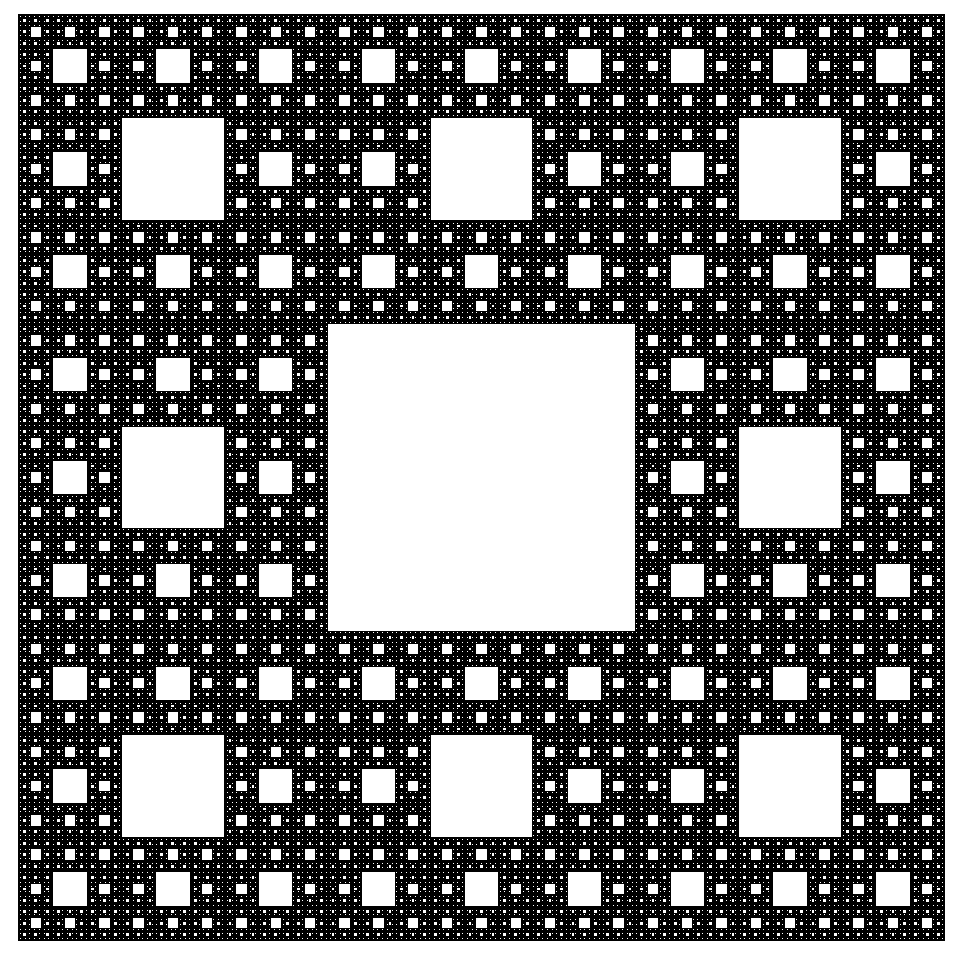
Sierpiński Carpet

Let S_0=[0,1]^{2} be the unit square. If S_m is defined, we let S_{m+1} be the set of all (x_1,x_2)\in \mathbb{R}^{2} such that there exist (a_1,a_2)\in \{0,1,2\}^{2} such that (3x_1-a_1,3x_2-a_2) \in S_m and such that a_1 and a_2 are not both equal to 1. The Sierpiński Carpet is the intersection S_{\infty}=\bigcap_{m\geq 0}S_m. This space was originally constructed by Waclaw Sierpiński in 1916 in [3].

The Sierpinski Carpet

Topological Properties:  Planar 1-dimensional Peano continuum (path-connected, locally path-connected, compact metric space). Unlike the Sierpiński triangle, the Sierpinski carpet has no local cut points (for any connected U neighborhood of any point x, the set U\backslash \{x\} is connected).

Other constructions: As a Planar 1-dimensional Peano continuum, S_{\infty} can also be constructed as an inverse limit \varprojlim_{n}G_n of finite planar graphs G_n.

Universality and Characterization: The Sierpiński Carpet is universal for one-dimensional separable metric spaces. That is, every one-dimensional separable metric spaces embeds as a subspace of S_{\infty}. Gordon Whyburn [4] proved that any 1-dimensional planar Peano continuum having no local cut-points is homeomorphic to the Sierpiński carpet.

Fundamental Group: \pi_1(S_{\infty}) embeds as the subgroup of an inverse limit \varprojlim_{n}F_n of finitely generated free groups [2]. This group is uncountable, residually free, torsion free, locally free, locally finite.

Perfectly Wild: One of the really special things about the Sierpinski Carpet is that all of it’s points are \pi_1-wild points, meaning that S_{\infty} is not semilocally simply connected at any of its point. Just as a space without isolated points is called a “perfect space,” it makes sense to say that S_{\infty} is perfectly \pi_1-wild or just perfectly wild if the fundamental group context is clear.

Because S_{\infty} is perfectly wild the fundamental determines its homotopy type and even it’s homeomorphism type [1]. Formally, if X is a one-dimensional Peano continuum and \pi_1(X)\cong \pi_1(S_{\infty}) as abstract groups, then X\simeq S_{\infty} Moreover, if X is everywhere wild, then X\cong S_{\infty}.

Higher homotopy groups: \pi_n(S_{\infty})=0 for n\geq 2, i.e. S_{\infty} is aspherical.

Homology groups: \widetilde{H}_n(S_{\infty})=\begin{cases} \prod_{\mathbb{N}}\mathbb{Z}\oplus\prod_{\mathbb{N}}\mathbb{Z}/\bigoplus_{\mathbb{N}}\mathbb{Z}, & n=1 \\ 0, & n \neq 1   \end{cases}

Cech homotopy groups: \check{\pi}_n(S_{\infty})=\begin{cases}  \varprojlim_{n}F_{n}, & n=1 \\ 0, & n\neq 1   \end{cases}

Cech homology groups: \check{H}_n(S_{\infty})=\begin{cases} \mathbb{Z}, & n=0 \\ \prod_{\mathbb{N}}\mathbb{Z}, & n=1 \\ 0, & n \geq 2   \end{cases}

Cech cohomology groups: \check{H}_n(S_{\infty})=\begin{cases} \mathbb{Z}, & n=0 \\ \bigoplus_{\mathbb{N}}\mathbb{Z}, & n=1 \\ 0, & n \geq 2   \end{cases}

Other Properties:

  • Semi-locally simply connected: No, not at any of it’s points.
  • Traditional Universal Covering Space: No
  • Generalized Universal Covering Space: Yes
  • Homotopically Hausdorff: Yes
  • Strongly (freely) homotopically Hausdorff: Yes
  • Homotopically Path-Hausdorff: Yes
  • 1UV_0: Yes
  • \pi_1-shape injective: Yes

References:

[1] G. Conner, K. Eda, Fundamental groups having the whole information of spaces, Topology Appl. 146-147 (2005) 317-328.

[2] K. Eda, K. Kawamura, The fundamental groups of one-dimensional spaces, Topology Appl. 87 (1998) 163-172.

[3] W. Sierpiński, Sur une courbe cantorienne qui contient une image biunivoque et continue de toute courbe donnée. C. R. Acad. Sci. Paris (in French) 162 (1916), 629–632.

[4] G. Whyburn, Topological chcracterization of the Sierpinski curve. Fund. Math. 45 (1958), 320–324