I’m going to take a little break from the topologized fundamental group series for a bit. That’s a long series and a distraction might be nice. Right now, I’m going to share a little about a property I’ve been running into pretty frequently. First, a standard definition in homotopy theory.
Definition 1: A space is n-connected if is trivial for all (and some or any choice of basepoint), that is, if is path connected (0-connected) and the first through n-th homotopy groups are trivial.
Definition 2: A space is locally n-connected at if for every neighborhood of , there exists an n-connected neighborhood of such that . A space is locally n-connected if it is locally n-connected at all of its points.
Lots of spaces are locally n-connected but when you’re proving general theorems it can be difficult or impossible to actually build n-connected open sets using general methods. There is a larger class of spaces that’s often more conducive to creating and proving general results. This is the property. The fact that so many old/classic papers use this property without defining it makes me feel that it used to be more broadly used and understood. Certainly, it’s still used in metric topology and shape theory (and of course wild topology). Even though the terminology and notation are definitely established, whenever I do use it, I feel the need to define it. Personally, I feel that unless one already knows the difference, it’d be easy to see “LCn ” for the first time and assume that this means locally n-connected…you know..because of the letters.
Definition 3: A space is at if for every neighborhood of , there exists a neighborhood of such that and such that for every , every map is null-homotopic in . A space is if it is at all of its points.
The key difference between the two definitions is that in the locally n-connected definition, is chosen so that a map from a -spheres () actually can be contracted in . In the definition, is chosen so that all maps contract within the slightly larger open set . Certainly, we have:
locally n-connected at at
Examples illustrating the difference between these properties can take us to wild places so let’s work some out in low dimensions. We’ll sort out the 0-dimensional case in the remainder of this post and discuss higher dimensions in the next post.
Local 0-connectivity and
A space being locally 0-connected at a point means being locally path-connected. In this case, has a basis of path-connected open sets at . In contrast, means that is “relatively locally path-connected.” Given any small neighborhood , we can find a smaller neighborhood so that a map (where ) extends to a path . In short, any two points in can be connected by a path in but maybe not by a path in . We could be worried that this path in is too big. But remember that was already an arbitrarily small neighborhood so it is still relatively small when compared with the neighborhood . See below for an image of the two cases.
If a space is locally 0-connected at a point, V may be chosen so any map f from {-1,1} to V can be extended to a path within V (top). If the space is LC0 at a point, one may chose V but only be able to extend f to a path within U (bottom).
Because the property is a relative-size-type property, we have to stretch our brains a bit when searching for an example that distinguishes the two properties. Here’s an example of a space with a point where you have the property but not locally path connectivity.
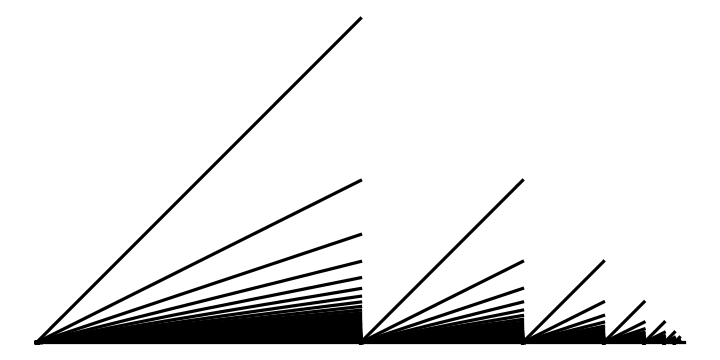
Example 4: Consider the planar set illustrated below.
A compact planar set which is LC0 but not locally 0-connected at its rightmost point. Note that it does fail to be LC0 at all points in .
Let’s say we embed this space in the plane so the bottom arc is the closed unit interval on the x-axis. This space is locally path-connected at all points with positive y-component. It’s clearly not locally path connected at any point in but it’s less obvious what is happening at because the fans are shrinking in diameter.
First, let’s show that this space is not locally 0-connected at the rightmost point : Any neighborhood of contains one of the fan-vertices for some smallest . This is going to have to contain some of the points for but there’s no way to connect to such a point with a path in because that path would need to pass through . One can deduce from this observation that any path-connected neighborhood of must contain the entire bottom arc. So is not locally path connected at .
On the other hand, is at . A basic neighborhood of is of the form , . Given , the set is not path connected. However, any two points in can be connected by a path in because you’re allowed to move left just far enough to get to the nearest fan-vertex on the x-axis.
The above space is a compact, one-dimenisonal, planar metric space. However, it’s not a dendrite because it’s not locally connected (or even ) at several points. Actually, in Example 4, we were only able to verify that is but not locally 0-connected at because there are points besides where is not . Another way to look at it is this – in dimension , the pointwise properties are not equivalent but the global properties are. This is formalized in the next proposition.
Proposition 5: A space is if and only if it is locally 0-connected.
Proof. One direction is clear. Suppose is at all of its points. Let and be an open neighborhood of . It suffices to show that the path component of in is open in . Let , then by assumption, we can find a neighborhood of such that and such that every point can be connected to by a path in . But since is the path component of in , we have . This proves that is open.
Sequentially 0-connected spaces
For first countable spaces, it’s possible to characterize the pointwise property using the following definition.
Definition 6: A space is sequentially 0-connectedat if for every convergent sequence , there exists a path such that and . We say is sequentially 0-connected if it is sequentially 0-connected at all of its points.
I’ve been finding sequential properties like this really useful lately and there are several equivalent ways to define this property. Basically this property means that every convergent sequence extends to a continuous path. The sequentially 0-connected property is the sequential analogue of the property. I’ll justify this claim in the next theorem. In papers, I have claimed this proof is “elementary” but I don’t know of a reference for it. It will make me feel better if the proof is here.
Theorem 7: Suppose is first countable at . Then is at if and only if X is sequentially 0-connected at .
Proof. For both directions, let be a neighborhood base at . First, suppose is at and let be a convergent sequence. Find a neighborhood of such that and such that any two points in can be connected by a path in . Let . Since , it must be that . Let from to . Then every neighborhood of contains for all but finitely many . This means the infinite path-concatenation is well-defined, continuous, maps to and to .
For the other direction, suppose is not at . Then there exists open neighborhood of such that for every neighborhood of in , there exists two points in that cannot be connected by a path in . In particular, there must be some point such that and cannot be connected by a path in (if this were not the case, the previous sentence would be violated using path concatenation). Let’s assume that we have our neighborhood base . Then for every , there exists such that there is no path in from to . Note that since we are choosing points from a neighborhood base. Also, it is not possible to find a continuous path with and . Indeed, such a path would have for some and thus restrict to a path from to ; a contradiction. Since the convergent sequence cannot be extended to a path, we conclude that cannot be sequentially 0-connected at .
Since the space in Example 4 is a metric space, that example is sequentially 0-connected but not locally 0-connected. The next example is not a metric space but is more extreme. It’s topology is so large and fine that the space is sequentially 0-connected but not .
Example 8: Let be the first compact uncountable ordinal (with maximal element . We give the topology generated by singletons , and the cofinal sets . The key thing to know about is that there is no sequence of countable ordinals that converges to the maximal point . For each , attach an arc to by identifying and . Let be the resulting space with the weak topology with respect to the subspaces and , . Any sequence in that converges to eventually lies in for some fixed . All such sequences extend to a path and it follows that is sequentially 0-connected at (and thus at all of its points).
However, this space is not at . Let be the union of the images of all copies of in . Any open neighborhood of in will contain elements of but will not contain any arc . Thus there is no way to connect to the elements of by a path in or . We conclude that is not at .
The space in Example 8 is constructed by attaching arcs to the first compact uncountable ordinal (but with a modified topology).
Example 9: There is an example of a locally path-connected space, which is not sequentially 0-connected. This rather remarkable example using the Axioms of Choice is constructed by Taras Banakh in an answer to this MO question of mine. It is even -generated!
Examples 4,8, and 9 show that the pointwise-sequentially 0-connected property is comparable to neither the locally 0-connected property nor the property.
We’ll deal with the difference between local 1-connectivity and in the next post.


![[-1,1]\to U](https://s0.wp.com/latex.php?latex=%5B-1%2C1%5D%5Cto+U&bg=ffffff&fg=333333&s=0&c=20201002)

 .
.


![U_n=X\cap (1-2^{-n},1]\times \mathbb{R}](https://s0.wp.com/latex.php?latex=U_n%3DX%5Ccap+%281-2%5E%7B-n%7D%2C1%5D%5Ctimes+%5Cmathbb%7BR%7D&bg=ffffff&fg=333333&s=0&c=20201002)


![\alpha:[0,1]\to X](https://s0.wp.com/latex.php?latex=%5Calpha%3A%5B0%2C1%5D%5Cto+X&bg=ffffff&fg=333333&s=0&c=20201002)


![\beta_m:[0,1]\to U_n](https://s0.wp.com/latex.php?latex=%5Cbeta_m%3A%5B0%2C1%5D%5Cto+U_n&bg=ffffff&fg=333333&s=0&c=20201002)

![\beta_m([0,1])](https://s0.wp.com/latex.php?latex=%5Cbeta_m%28%5B0%2C1%5D%29&bg=ffffff&fg=333333&s=0&c=20201002)





![\alpha([(n-1)/n,1])\subseteq W](https://s0.wp.com/latex.php?latex=%5Calpha%28%5B%28n-1%29%2Fn%2C1%5D%29%5Csubseteq+W&bg=ffffff&fg=333333&s=0&c=20201002)
![\alpha|_{[(n-1)/n,1]}:[(n-1)/n,1]\to W](https://s0.wp.com/latex.php?latex=%5Calpha%7C_%7B%5B%28n-1%29%2Fn%2C1%5D%7D%3A%5B%28n-1%29%2Fn%2C1%5D%5Cto+W&bg=ffffff&fg=333333&s=0&c=20201002)


![(\lambda,\omega_1]=\{\kappa\mid \kappa>\lambda\}](https://s0.wp.com/latex.php?latex=%28%5Clambda%2C%5Comega_1%5D%3D%5C%7B%5Ckappa%5Cmid+%5Ckappa%3E%5Clambda%5C%7D&bg=ffffff&fg=333333&s=0&c=20201002)


![A_{\lambda}=[0,1]](https://s0.wp.com/latex.php?latex=A_%7B%5Clambda%7D%3D%5B0%2C1%5D&bg=ffffff&fg=333333&s=0&c=20201002)


![[0,1/3)\cup (2/3,1]\subset A_{\lambda}](https://s0.wp.com/latex.php?latex=%5B0%2C1%2F3%29%5Ccup+%282%2F3%2C1%5D%5Csubset+A_%7B%5Clambda%7D&bg=ffffff&fg=333333&s=0&c=20201002)


 Wild Topology
Pingback: Local n-connectivity vs. the LC^n Property, Part 2 | Wild Topology